
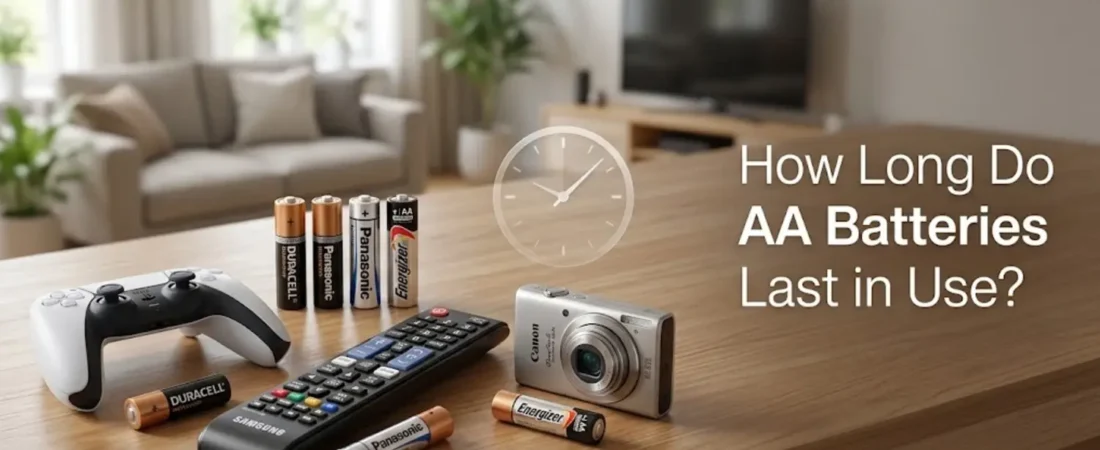
AA batteries can last anywhere from a few hours to several months in active use, depending on the device, battery chemistry, power consumption, and how often the equipment operates. A battery powering a motorized toy will usually be used up much faster than one in a simple wall clock. Even two devices that use AA batteries can have very different runtimes.
That is why there is no single answer to how long an AA battery lasts. The most useful estimate comes from understanding the battery type and the amount of energy the device consumes.
Disposable alkaline AA batteries are common because they are easy to find and require no charger. Rechargeable nickel-metal hydride (NiMH) AA batteries are useful for many frequently used devices because they can be charged and reused. Both types have advantages, but their performance depends on the application.
This guide explains what affects AA battery runtime, how to estimate it, and what you can do to get more reliable performance from your batteries.
How Long Does an AA Battery Typically Last?
AA battery runtime varies widely because devices consume energy at different rates. A low-power clock may operate for a long period, while a bright flashlight or motorized toy may use the battery’s available energy much more quickly.
The following table provides general examples rather than guaranteed runtimes.
| Device or use | What to expect |
|---|---|
| Wall clock | Often months or longer, depending on the clock and battery |
| TV remote control | Often several months or longer with normal use |
| Wireless mouse | Can last weeks or months, depending on activity and features |
| Flashlight | May last hours or longer depending on brightness and battery type |
| Motorized toy | May use batteries over several hours of cumulative operation |
| Camera or high-drain accessory | Runtime can be shorter and depends heavily on the model and usage |
| Portable radio | Can last many hours, depending on volume, features, and battery chemistry |
These examples are broad because product designs differ. A flashlight on its brightest setting may consume energy far faster than the same flashlight on a low setting. A wireless mouse with advanced lighting may need more power than a basic model.
For a realistic estimate, check the device manual for its expected battery life or power consumption. Manufacturer guidance is generally more useful than applying a single runtime figure to every AA-powered product.
What Factors Affect AA Battery Life During Use?
1. Battery chemistry
The type of AA battery makes a difference to its discharge behavior, usable capacity, shelf life, and suitability for particular loads.
Alkaline AA batteries are disposable and are commonly used in remote controls, clocks, toys, and other household equipment. They are convenient when charging is not practical.
NiMH rechargeable AA batteries are designed to be charged and reused with a compatible charger. They are often useful in devices that consume batteries regularly, particularly where repeated replacement would be inconvenient.
Other AA-size battery products, including some lithium-based designs, have different performance characteristics. Always check the label and device instructions before choosing a replacement.
2. How much power the device consumes
The device’s power demand is one of the biggest influences on runtime. Electronics that draw very little current can operate for a long time, while devices that power motors, bright lights, speakers, or other demanding components can use stored energy quickly.
A remote control may spend most of its time in standby, drawing only small amounts of power when buttons are pressed. A motorized toy, by contrast, may draw substantial current while moving.
This means the same battery model can deliver very different results in different devices. A capacity rating cannot predict runtime accurately without information about the load and operating conditions.
3. How frequently the device is used
A device that runs continuously consumes energy differently from one that operates only occasionally. For example, a flashlight used for ten minutes a day may provide many separate sessions before the batteries need replacing. The same flashlight left on continuously will deplete them much sooner.
Some devices also use power while apparently switched off. Standby circuits, wireless connections, displays, and memory functions can continue drawing current. If battery life seems unusually short, check whether the device has a standby mode or features that can be disabled.
4. Temperature
Battery performance changes with temperature. Cold conditions can reduce the power a battery can deliver at a given moment, while high temperatures can accelerate aging during storage.
If a device is used outdoors, in a cold garage, or in a hot environment, its battery life may differ from the manufacturer’s typical indoor results. Follow the battery and device manufacturers’ temperature recommendations.
5. Battery age and storage
A battery can lose performance while sitting unused. The rate depends on its chemistry, age, storage temperature, and product design.
Use batteries within the manufacturer’s recommended period and store them in a cool, dry location within the stated temperature range. Avoid storing loose batteries where their terminals can touch metal objects.
Do Alkaline and Rechargeable AA Batteries Last the Same Amount of Time?
Not necessarily. Alkaline and rechargeable NiMH batteries have different voltage profiles and discharge characteristics, so their performance depends on the device.
A disposable alkaline AA battery is commonly rated at 1.5 volts nominally. A rechargeable NiMH AA battery is typically rated at 1.2 volts nominally. Some devices operate well with both, while others have specific voltage requirements or battery indicators that behave differently with rechargeable cells.
NiMH batteries can be well suited to devices with frequent or relatively demanding use. However, the runtime from a particular rechargeable cell depends on its capacity, condition, discharge rate, and the device’s cutoff voltage.
Alkaline batteries may be convenient for equipment used occasionally, but their performance can vary under heavy loads. Neither chemistry is automatically the best option for every device.
For a closer look at battery selection and charging, read our guide to how rechargeable batteries work.
How Can You Estimate AA Battery Runtime?
A rough runtime estimate can be calculated if you know the battery’s usable capacity and the current drawn by the device.
A simplified formula is:
Estimated runtime in hours = usable capacity in mAh ÷ average current draw in mA
For example, suppose a battery provides an illustrative usable capacity of 2,000 mAh under the relevant test conditions, and a device draws an average of 200 mA. A simple calculation gives:
2,000 mAh ÷ 200 mA = 10 hours.
This is only a theoretical estimate. Real runtime may be shorter because usable capacity depends on the battery chemistry, discharge rate, temperature, voltage cutoff, battery age, and the way the device operates. Many devices also draw different amounts of current at different times.
The capacity printed on a battery should not be treated as a guaranteed amount of energy available in every application. When possible, use manufacturer runtime data for the actual device and battery type.
Why Do AA Batteries Run Out Faster in Some Devices?
A battery may appear to have poor performance when the real cause is the device or its operating conditions.
For example, a flashlight’s high-brightness mode may draw much more current than its low setting. A toy with a motor can demand a surge of power when starting or changing direction. A camera may consume extra energy when using a flash, display, wireless features, or continuous recording.
Loose battery contacts can also cause intermittent power. Dirt, corrosion, or an incorrectly installed cell may prevent the device from receiving power consistently. If batteries run out unusually quickly, inspect the battery compartment and follow the manufacturer’s cleaning instructions.
Other possible causes include old batteries, incompatible battery chemistry, a device that remains switched on, or a faulty electronic component. If fresh batteries repeatedly fail in the same device, consult the device manual or manufacturer rather than assuming every replacement battery is defective.
How Can You Make AA Batteries Last Longer?
A few practical habits can help you get more useful runtime from AA batteries.
Switch off devices when possible
Turn off flashlights, toys, and other equipment when they are not needed. If a device offers power-saving settings, use them when they do not interfere with its purpose.
Match the battery to the device
Use the chemistry and battery type recommended by the manufacturer. A battery that works well in a remote control may not be the most suitable choice for a high-drain device.
Store spare batteries correctly
Keep batteries in a cool, dry place within the manufacturer’s recommended temperature range. Do not leave them in direct sunlight, a hot vehicle, or another environment that exceeds their storage limits.
Avoid mixing batteries
When a device uses more than one AA battery, follow its instructions about replacement. Do not mix old and new batteries or combine different chemistries and charge levels unless the manufacturer specifically permits it. Uneven discharge can cause problems and may increase the risk of leakage.
Keep contacts clean
Battery terminals and device contacts should be free of contamination. If you see corrosion, follow the manufacturer’s recommended cleaning procedure. Do not use a device if leakage has damaged its contacts or internal components.
Remove batteries from stored equipment when appropriate
If equipment will remain unused for a long period, check its manual for battery-removal recommendations. Removing batteries when advised can reduce the risk of damage caused by leakage.
How Do You Know When AA Batteries Need Replacing?
Many devices provide a low-battery warning, become dimmer, slow down, or stop operating normally when battery voltage falls below their required level. These signs can indicate that the batteries need replacing or recharging.
However, a device stopping does not always mean every bit of energy has been used. Some electronics stop working once voltage falls below a particular threshold, even though the battery may retain some energy that the device cannot use.
A basic voltage reading may help identify a depleted cell, but voltage measured without a load does not always show how well a battery will perform during actual operation. Use a suitable battery tester if you need a more useful assessment, and follow its instructions.
Replace batteries that are leaking, corroded, physically damaged, or unusually hot. Do not continue using a damaged cell.
Are Rechargeable AA Batteries Better for Frequent Use?
They can be a practical choice when a device consumes batteries regularly. Instead of repeatedly buying disposable cells, you can recharge compatible NiMH batteries using the correct charger.
The long-term value depends on the initial price, charger cost, number of useful cycles, electricity use, and how often the batteries are used. Rechargeable batteries also lose capacity as they age, so they will eventually need replacement.
For devices used only occasionally, disposable alkaline batteries may be simpler. For frequently used controllers, toys, flashlights, and compatible electronics, rechargeables may reduce repeated purchases.
Do not attempt to recharge ordinary disposable alkaline AA batteries. Use only batteries explicitly labelled rechargeable and follow the charging instructions for their chemistry.
Common Misunderstandings About AA Battery Life
One common misunderstanding is that all AA batteries have the same capacity because they share the same size. In reality, their chemistry, design, and intended application can differ significantly.
Another is assuming a battery’s advertised capacity translates directly into hours of use. Runtime depends on the load and the conditions in which the capacity is measured.
It is also easy to confuse storage life with runtime. A battery may retain useful charge while stored for a long time, yet provide a relatively short runtime in a demanding device. Conversely, a battery designed for frequent use may be a better choice for equipment that consumes energy quickly.
Finally, replacing a battery with a different chemistry without checking compatibility can cause unexpected performance. Follow the device’s recommendations instead of choosing solely by price or voltage printed on the label.
Final Verdict
AA batteries can last from hours to months during active use, but the actual runtime depends on the device, battery chemistry, power demand, temperature, and usage pattern. Low-power electronics generally consume energy more slowly than motorized toys, bright flashlights, and other demanding devices.
For the most reliable estimate, check the device manufacturer’s guidance and compare battery performance under similar conditions. Choose a compatible battery type, store it properly, and avoid mixing different batteries in the same device. These steps can help you get more predictable performance and make better decisions about when to use disposable or rechargeable AA batteries.