
Pencil batteries are used in more everyday devices than most people realize. From television remotes and wireless mice to wall clocks, toys, and flashlights, these small cylindrical batteries provide reliable power for household electronics.
But how many volts does a pencil battery actually produce?
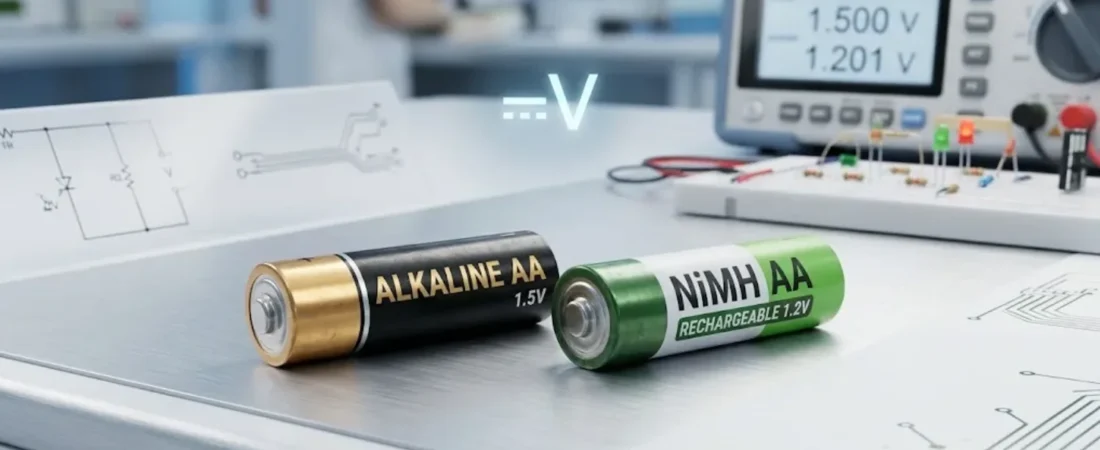
A standard alkaline AA pencil battery has a nominal voltage of 1.5 volts (1.5V). However, rechargeable AA batteries usually have a nominal voltage of 1.2 volts. Although both batteries share the same physical size, their voltage and performance characteristics are different.
Understanding pencil battery voltage can help you choose the correct replacement, avoid compatibility problems, and get better performance from your electronic devices.
In this guide, you’ll learn how pencil battery voltage works, how different battery types compare, how to test a battery using a multimeter, and how many volts multiple batteries produce when connected together.
What Is a Pencil Battery?
A pencil battery is a small cylindrical battery commonly used to power portable electronic devices. Its name comes from its long, narrow shape, which resembles an ordinary pencil.
In everyday usage, the term pencil battery generally refers to the AA battery, although naming conventions can vary between countries.
AA batteries are popular because they offer a convenient balance between physical size, capacity, and everyday power requirements. They are also widely available in different chemical types, including alkaline, zinc-carbon, nickel-metal hydride, and lithium.
Is a Pencil Battery the Same as an AA Battery?
In most everyday situations, yes. A pencil battery usually refers to a standard AA battery.
However, AA describes the battery’s physical size rather than its internal chemistry. An alkaline AA battery and a rechargeable NiMH AA battery may look almost identical, but their voltage ratings are different.
This distinction is important when purchasing replacement batteries because fitting into the same compartment does not automatically guarantee identical electrical performance.
Where Are Pencil Batteries Commonly Used?
You can find AA pencil batteries in many household and portable electronic products, including:
- Television and air-conditioner remote controls
- Wireless computer mice and keyboards
- Wall clocks and alarm clocks
- Children’s electronic toys
- Portable radios
- LED flashlights
- Digital cameras and other compatible accessories
The battery type required depends on the manufacturer’s recommendations and the device’s electrical requirements.
What Is the Standard Pencil Battery Voltage?
The standard nominal voltage of an alkaline AA pencil battery is 1.5V.
This is the voltage rating commonly printed on battery packaging. It represents the battery’s nominal operating voltage, not a promise that it will produce exactly 1.5 volts throughout its entire lifespan.
For example, a new alkaline AA battery may show a reading above 1.5V when tested without a connected device. As the battery supplies electricity, its voltage gradually decreases.
Energizer’s official EN91 AA alkaline battery datasheet identifies its nominal voltage as 1.5 volts.
You can check the manufacturer’s AA alkaline battery specifications for further technical information.
Why Is an Alkaline Pencil Battery Rated at 1.5V?
An alkaline battery generates electricity through a chemical reaction involving zinc and manganese dioxide.
These materials determine the electrical potential inside the battery. When the battery is connected to an electronic device, the chemical reaction allows electrical current to flow through the external circuit.
The 1.5V rating is based on the characteristics of this battery chemistry.
This also explains why rechargeable batteries can have a different voltage rating even when they share the same physical dimensions.
Nominal Voltage vs. Actual Voltage
Nominal voltage and actual voltage are two different measurements.
Nominal voltage is the standard rating assigned to a battery, while actual voltage is the reading measured at a particular moment.
For example, a fresh alkaline AA battery may measure more than 1.5V when it is not connected to a device. Under an electrical load, the voltage may be lower.
Several factors influence the actual reading:
- Remaining battery charge
- Electrical current drawn by the device
- Internal resistance
- Battery temperature
- Age and storage conditions
This is why a single voltage measurement does not always reveal how much usable energy remains inside a battery.
Pencil Battery Voltage by Battery Type
Not all pencil batteries have the same voltage. Their electrical characteristics depend on the chemical materials used inside the cell.
Here is a comparison of common AA battery types.
| Battery Type | Nominal Voltage | Rechargeable |
|---|---|---|
| Alkaline AA | 1.5V | No |
| Zinc-carbon AA | 1.5V | No |
| NiMH rechargeable AA | 1.2V | Yes |
| Primary lithium AA | 1.5V | No |
| Regulated lithium-ion AA-format battery | 1.5V on some models | Yes, depending on design |
Always check the product label because lithium-ion AA-format rechargeable products can have different output designs and specifications.
1. Alkaline Pencil Battery
Alkaline batteries are among the most widely used AA batteries in households.
They provide a nominal voltage of 1.5V and are commonly found in supermarkets, electronics stores, and general retailers.
Their advantages include convenience, good shelf life, and compatibility with many everyday electronic devices.
They are suitable for products such as remote controls, clocks, toys, and portable accessories.
However, ordinary alkaline batteries are not rechargeable. Attempting to recharge them can cause leakage, overheating, or rupture.
2. Zinc-Carbon Pencil Battery
Zinc-carbon batteries also have a nominal voltage of 1.5V.
However, they generally offer lower capacity and less performance under heavier electrical loads than comparable alkaline batteries.
They may be suitable for simple, low-power devices such as basic clocks and certain remote controls.
For electronics that consume more power, an alkaline battery may provide better performance if supported by the device manufacturer.
3. Rechargeable NiMH Pencil Battery
Nickel-metal hydride batteries are a popular option for people who regularly use battery-powered electronics.
A standard rechargeable NiMH AA battery has a nominal voltage of 1.2V rather than 1.5V.
Although its nominal voltage is lower, NiMH batteries maintain a relatively stable voltage through much of their discharge cycle. This makes them suitable for many devices designed to accept AA alkaline batteries.
Their biggest advantage is reusability. Instead of disposing of a battery after one use, you can recharge it using a compatible NiMH charger.
Panasonic’s official eneloop specifications list a nominal voltage of 1.2V for its AA rechargeable batteries.
4. Primary Lithium Pencil Battery
Primary lithium AA batteries are non-rechargeable batteries that generally provide a nominal voltage of 1.5V when using lithium iron disulfide chemistry.
They can be useful in devices that benefit from long storage life, relatively low weight, or operation across a wider temperature range.
It is important not to confuse these disposable lithium batteries with rechargeable lithium-ion products. Their internal chemistry and charging requirements are different.
1.2V vs. 1.5V Pencil Battery: What’s the Difference?
One of the most common questions about pencil batteries is whether a 1.2V rechargeable battery can replace a 1.5V alkaline battery.
The answer depends on the electronic device.
Both battery types have the same standard AA physical format, but their electrical characteristics are different.
| Feature | 1.5V Alkaline | 1.2V NiMH |
|---|---|---|
| Battery chemistry | Alkaline | Nickel-metal hydride |
| Nominal voltage | 1.5V | 1.2V |
| Rechargeable | No | Yes |
| Voltage behavior | Gradually decreases | Relatively stable through much of discharge |
| Typical application | Household electronics | Frequently used rechargeable devices |
| Charging requirement | Not rechargeable | Compatible NiMH charger |
Many household electronics can operate with either battery type. However, some devices may display a low-battery warning earlier or behave differently when using 1.2V rechargeable batteries.
Before switching battery types, check the manufacturer’s instructions.
The important thing to remember is that physical compatibility does not always mean electrical compatibility.
How Many Volts Do 2, 3, and 4 Pencil Batteries Produce?
The total voltage depends on how the batteries are connected.
When identical batteries are connected in series, their nominal voltages add together.
For standard 1.5V alkaline pencil batteries, the results are:
| Number of Batteries | Total Nominal Voltage |
|---|---|
| 1 battery | 1.5V |
| 2 batteries | 3V |
| 3 batteries | 4.5V |
| 4 batteries | 6V |
| 6 batteries | 9V |
For example, two 1.5V alkaline AA batteries connected in series provide a nominal output of 3V.
The same calculation applies to rechargeable NiMH batteries, but the starting voltage is different.
Two 1.2V NiMH batteries connected in series provide 2.4V, while four provide 4.8V.
This information is useful when understanding battery compartments, portable electronics, and battery-powered equipment.
How to Check Pencil Battery Voltage With a Multimeter
If you have an old pencil battery and are unsure whether it still works, a digital multimeter can help you measure its voltage.
A basic digital multimeter is sufficient for this test. You do not need expensive electronic testing equipment to perform a simple voltage measurement.
Tools You Need
Prepare the following items:
- A digital multimeter
- The AA pencil battery you want to test
- Red and black multimeter probes
Before testing, inspect the battery. Do not handle or test batteries that are leaking, swollen, corroded, or physically damaged.
Step-by-Step Testing Instructions
Step 1: Turn on the multimeter
Switch on your digital multimeter and make sure its probes are connected to the correct sockets.
The black probe normally connects to COM, while the red probe connects to the voltage measurement socket.
Step 2: Select DC voltage mode
Choose the DC voltage setting, usually marked as V with a straight line and a dashed line.
If your multimeter requires manual range selection, choose a suitable range for measuring approximately 1.5 volts.
Step 3: Identify the battery terminals
A standard AA pencil battery has two terminals:
- Positive (+): The raised metal button at the top.
- Negative (-): The flat metal surface at the bottom.
Step 4: Connect the probes
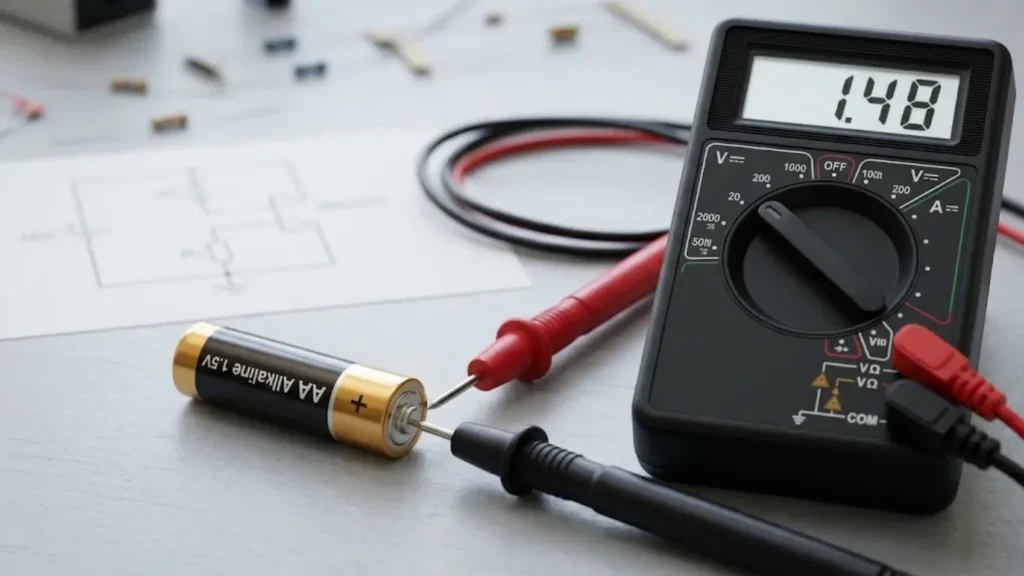
Touch the red probe to the positive terminal and the black probe to the negative terminal.
Keep the probes steady and avoid connecting the two battery terminals directly to each other.
Step 5: Read the voltage
Look at the multimeter display to see the measured voltage.
A fresh alkaline AA battery may show a reading above its nominal 1.5V rating when tested without a load.
A lower reading may indicate that the battery has been used, but the result should be interpreted according to its chemistry and testing conditions.
How to Understand the Multimeter Reading
A voltage reading can help identify possible battery problems, but there is no universal voltage threshold that identifies every AA battery as good or completely empty.
Alkaline and rechargeable NiMH batteries have different discharge characteristics. Their readings should not be interpreted using exactly the same expectations.
A battery may also show a reasonable voltage without a load but experience a significant voltage drop when connected to a device.
For a more reliable assessment, technicians use an appropriate load test to examine how the battery performs while supplying current.
Safety tip: Never switch a multimeter to current mode and connect it directly across a battery. This can create a short circuit and damage the meter or battery.
What Voltage Is Considered Low for an AA Battery?
There is no single low-voltage reading that applies to every AA battery.
The correct interpretation depends on battery chemistry, discharge conditions, and the operating requirements of the electronic device.
For alkaline batteries, voltage gradually decreases as the battery supplies power. A device may stop working when the voltage falls below its operating requirements, even if some energy remains inside the battery.
NiMH batteries behave differently. Their voltage stays relatively stable through much of their discharge cycle before dropping more noticeably near the end.
This is why a rechargeable 1.2V battery should not be judged using the same expectations as a 1.5V alkaline battery.
If you are unsure whether a battery is still usable, consider its chemistry, the device’s requirements, and its performance under an appropriate load.
How Long Does a Pencil Battery Last?
There is no fixed lifespan for every pencil battery. Its operating time depends on battery chemistry, capacity, device power consumption, and usage patterns.
For example, an alkaline AA battery in a television remote may last considerably longer than one used in a high-powered toy or flashlight.
Several factors influence battery life:
Device power consumption: Devices that draw more electrical current generally drain batteries faster.
Battery capacity: A battery with greater usable capacity can provide longer operating time under comparable conditions.
Usage pattern: A device used occasionally may consume less energy than one that operates continuously.
Temperature: Very hot or cold conditions can affect battery performance and available capacity.
Battery quality and age: Manufacturing quality, storage conditions, and expiry dates can influence performance.
If your device starts losing power quickly, inspect the batteries and check the manufacturer’s recommendations before assuming the electronic device itself is faulty.
Can You Replace a 1.5V Battery With a 1.2V Rechargeable Battery?
In many everyday devices, yes.
AA rechargeable NiMH batteries are designed to fit the same standard AA battery compartment as alkaline batteries. Many household electronics are compatible with both types.
However, some devices have specific voltage requirements and may not operate as expected with a 1.2V rechargeable battery.
Before switching, consider these points:
- Check the device manual for supported battery chemistries.
- Confirm that the replacement has the correct physical size.
- Use rechargeable batteries only when the device supports them.
- Charge NiMH batteries with a compatible charger.
- Avoid mixing old and new batteries or different battery chemistries.
If you’re interested in another type of rechargeable battery, read our guide to rechargeable 9V battery options.
If a device does not work properly with a rechargeable battery, follow the manufacturer’s battery recommendations.
Common Pencil Battery Problems and Safety Tips
Even the correct battery can cause problems if it is old, damaged, incorrectly installed, or stored poorly.
A few simple precautions can help protect both your batteries and electronic devices.
Check battery polarity: Always match the positive and negative markings inside the battery compartment.
Do not mix battery types: Avoid combining alkaline, zinc-carbon, and rechargeable batteries in the same device.
Replace batteries together: When a device uses multiple batteries, replace the complete set with matching batteries of the same type and age.
Avoid excessive heat: Keep batteries away from direct sunlight, heaters, and other hot environments.
Never recharge disposable batteries: Ordinary alkaline, zinc-carbon, and primary lithium batteries are not designed for recharging.
Watch for leakage: If a battery leaks, avoid direct contact with the material and follow the manufacturer’s cleaning and disposal instructions.
Store batteries safely: Keep loose batteries away from keys, coins, and other metal objects that could connect their terminals.
These precautions can help reduce the risk of battery damage, leakage, and accidental short circuits.
Frequently Asked Questions
How many volts is one pencil battery?
A standard alkaline AA pencil battery has a nominal voltage of 1.5 volts. A rechargeable NiMH AA battery typically has a nominal voltage of 1.2 volts.
Is AA battery voltage always 1.5V?
No. Alkaline, zinc-carbon, and primary lithium AA batteries generally have a nominal voltage of 1.5V. Rechargeable NiMH AA batteries typically have a nominal voltage of 1.2V.
Can a multimeter test a pencil battery?
Yes. Set the multimeter to DC voltage, connect the red probe to the positive terminal, and the black probe to the negative terminal. The display will show the battery’s measured voltage.
Can I recharge a 1.5V pencil battery?
Ordinary 1.5V alkaline and zinc-carbon batteries are not rechargeable. Only batteries specifically designed for recharging should be charged, using a compatible charger.
Why does a fresh AA battery measure more than 1.5V?
The 1.5V rating is the nominal voltage, not the maximum open-circuit voltage. A fresh alkaline AA battery can show a reading above 1.5V when it is not connected to a device.
How many volts do two pencil batteries produce?
Two standard 1.5V alkaline AA batteries connected in series provide a nominal voltage of 3V. Two 1.2V rechargeable NiMH batteries connected in series provide 2.4V.
Are pencil batteries and AAA batteries the same?
No. AA and AAA batteries are different physical sizes. Both may have a nominal voltage of 1.5V when alkaline, but AAA batteries are smaller and generally have less capacity than comparable AA batteries.
Final Thoughts
Understanding pencil battery voltage makes it easier to choose the right power source for everyday electronic devices.
The most important difference to remember is that a standard alkaline AA pencil battery has a nominal voltage of 1.5V, while a rechargeable NiMH AA battery typically provides 1.2V.
Although both batteries share the same physical size, their electrical characteristics are different. The right choice depends on your device’s requirements, battery chemistry, and whether you prefer disposable or rechargeable power.
Before purchasing replacements, check the manufacturer’s specifications and use a digital multimeter when you need to investigate a battery’s condition.
A little knowledge about battery voltage can help you maintain your devices, avoid compatibility problems, and make more informed battery choices.