
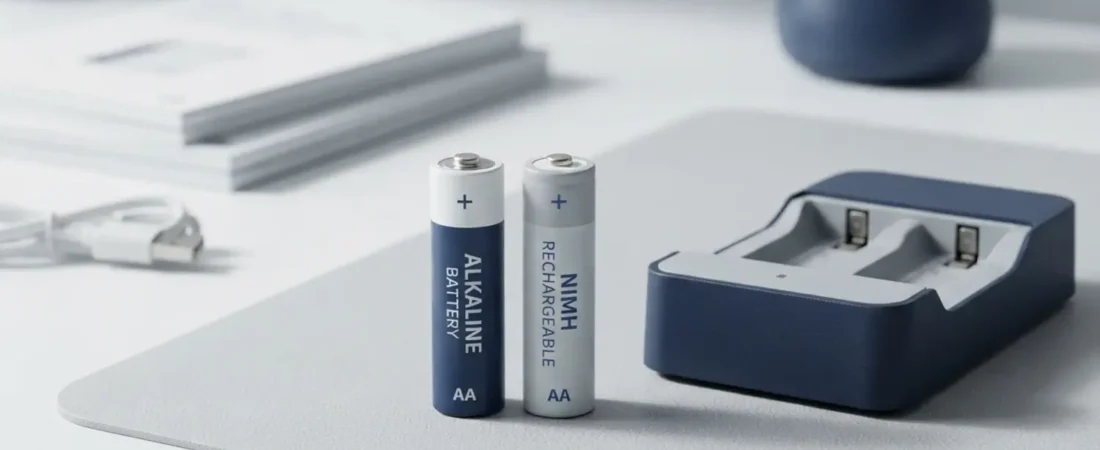
Not all AA batteries are rechargeable. Although they share the same physical size, AA batteries are manufactured using different chemical compositions, and their ability to accept a charge depends on the technology inside them.
Standard alkaline AA batteries are designed for single use and should not be placed in a battery charger. Rechargeable nickel-metal hydride (NiMH) batteries, on the other hand, are designed to be charged and reused with compatible charging equipment.
Some lithium-based AA-format batteries are also rechargeable, but others are disposable. This makes it important to check the battery label rather than relying on its appearance.
In this guide, you’ll learn which AA batteries are rechargeable, how to recognize different types, whether rechargeable batteries can replace alkaline cells, and how to charge them safely.
Why Aren’t All AA Batteries Rechargeable?
AA describes a battery’s physical size, not its internal chemistry.
Manufacturers produce AA batteries using different chemical systems. Some are designed to generate electricity through a reaction that cannot safely be reversed using an ordinary battery charger. These are called primary batteries.
Others use rechargeable chemical systems that allow the reaction to be reversed through a controlled charging process. These are known as secondary batteries.
This explains why two batteries can look almost identical but have different charging requirements.
For example:
- Standard alkaline AA batteries are generally non-rechargeable.
- Zinc-carbon AA batteries are disposable.
- NiMH AA batteries are rechargeable.
- NiZn AA batteries are rechargeable.
- Common consumer lithium AA batteries are generally disposable.
- Certain lithium-ion AA-format products are rechargeable and use specialized charging arrangements.
The most important distinction is that a battery’s chemistry determines whether it can be recharged safely.
Which AA Batteries Are Rechargeable?
Several battery technologies are available in the AA format. Understanding their differences can help you choose the right option for your electronic devices.
| AA battery type | Typical nominal voltage | Rechargeable? |
|---|---|---|
| Alkaline | 1.5V | No |
| Zinc-carbon | 1.5V | No |
| NiMH | 1.2V | Yes |
| NiZn | 1.6V | Yes |
| Lithium iron disulfide (primary lithium) | 1.5V | No |
| Regulated lithium-ion AA-format | Usually 1.5V output | Yes, if specifically designed for recharging |
Let’s examine the most common types.
1. Alkaline AA Batteries
Alkaline batteries are among the most widely available AA batteries. They are commonly used in television remotes, wall clocks, wireless keyboards, toys, and flashlights.
A standard alkaline AA battery has a nominal voltage of 1.5V.
Its advantages include convenient availability, good shelf life, and compatibility with many household electronic devices.
However, ordinary alkaline batteries are not designed for repeated charging. Attempting to recharge them can cause internal pressure to build up, potentially resulting in leakage, overheating, or rupture.
According to Duracell’s official battery FAQs, only batteries specifically marked as rechargeable should be charged.
Verdict: Standard alkaline AA batteries are disposable and should never be recharged.
2. Nickel-Metal Hydride (NiMH) AA Batteries
NiMH batteries are among the most popular rechargeable AA options.
They are designed to be charged and reused rather than discarded after one discharge cycle. Most standard NiMH AA batteries have a nominal voltage of 1.2V, slightly lower than the 1.5V rating of ordinary alkaline batteries.
Despite this difference, NiMH batteries work in many devices designed for standard AA cells.
Common applications include:
- Wireless gaming controllers
- Digital cameras
- Rechargeable flashlights
- Electronic toys
- Wireless computer accessories
- Portable household electronics
One major advantage is reusability. Depending on the manufacturer, battery model, and operating conditions, NiMH batteries can support hundreds of charging cycles or more.
Panasonic’s eneloop range is one example of rechargeable NiMH technology.
Verdict: NiMH AA batteries are rechargeable and suitable for many everyday devices that accept compatible AA cells.
3. Lithium AA Batteries
Lithium AA batteries can be confusing because the term lithium is used for different battery technologies.
Many common consumer lithium AA batteries use lithium iron disulfide chemistry. These batteries are designed for single use, not repeated charging.
They generally provide a nominal voltage of 1.5V and are useful in applications where long shelf life, low weight, or reliable performance in demanding conditions is important.
However, some rechargeable products are also marketed in AA-compatible formats using lithium-ion technology and electronic voltage regulation.
These products have different internal designs and charging requirements from disposable lithium AA batteries.
Never assume that a lithium AA battery is rechargeable simply because its label includes the word lithium.
Verdict: Common primary lithium AA batteries are non-rechargeable. Only specially designed rechargeable models should be charged using their specified charging system.
4. Nickel-Zinc (NiZn) AA Batteries
Nickel-zinc batteries are another rechargeable option available in AA sizes.
Unlike conventional NiMH batteries, which typically have a nominal voltage of 1.2V, NiZn batteries generally have a nominal voltage of approximately 1.6V.
This higher voltage can make them useful in certain devices that benefit from a voltage closer to that of alkaline batteries.
However, they are not automatically compatible with every device that accepts AA cells.
Their charging requirements also differ from those of NiMH batteries. Always use a charger specifically designed for the battery chemistry.
Verdict: NiZn AA batteries are rechargeable, but device compatibility and charger requirements must be checked.
How to Tell If an AA Battery Is Rechargeable
You do not need to identify a battery’s internal chemistry yourself to determine whether it can be charged. Start by examining its label and packaging.
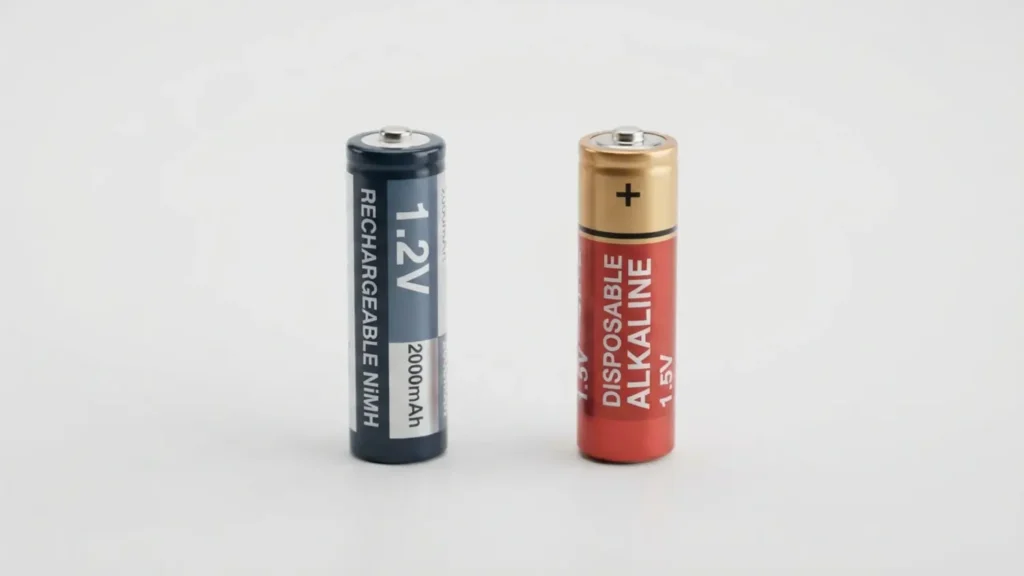
Here are five things to check.
1. Look for the Word Rechargeable
The clearest indication is the word “Rechargeable” printed on the battery or its packaging.
Manufacturers normally identify rechargeable products clearly so consumers can distinguish them from disposable alternatives.
2. Check the Battery Chemistry
Battery labels can provide useful information about the technology inside the cell.
Common rechargeable chemistry labels include:
- NiMH: Nickel-metal hydride
- NiZn: Nickel-zinc
- Rechargeable Li-ion: Lithium-ion
However, the chemistry name alone should not replace checking the manufacturer’s charging instructions.
3. Examine the Voltage Rating
A nominal voltage of 1.2V is common for rechargeable NiMH AA batteries.
Standard alkaline AA batteries generally have a nominal voltage of 1.5V.
However, voltage alone cannot establish whether a battery is rechargeable. Some rechargeable products also provide a regulated 1.5V output.
4. Read the Manufacturer’s Instructions
Check the manufacturer’s product page, packaging, or technical documentation.
Look for information about battery chemistry, charging cycles, compatible chargers, and charging precautions.
5. Check Charger Compatibility
Rechargeable batteries require charging equipment designed for their chemistry.
For example, a standard NiMH charger should be used for compatible NiMH batteries, not automatically for lithium-ion or NiZn products.
A useful rule is simple: never charge a battery unless the manufacturer explicitly identifies it as rechargeable.
Can You Recharge Regular 1.5V AA Batteries?
No. Ordinary 1.5V alkaline AA batteries are not designed to be recharged.
Some people assume that any battery can be reused if it is connected to a charger. This is incorrect and potentially dangerous.
Attempting to charge a disposable alkaline battery can cause:
- Battery leakage
- Excessive internal pressure
- Overheating
- Rupture
- Damage to the charger or nearby equipment
Panasonic specifically advises against charging alkaline and zinc-carbon batteries because doing so can create risks of leakage, rupture, fire, or explosion.
You can read its guidance in the official Panasonic dry battery FAQ.
It is also important to distinguish a rechargeable battery with a regulated 1.5V output from an ordinary alkaline battery. Some rechargeable products contain additional electronics to regulate their output voltage.
Always follow the instructions for the exact battery model.
What Is the Difference Between 1.2V and 1.5V AA Batteries?
Voltage is one of the main differences between conventional rechargeable and disposable AA batteries.
A typical alkaline AA battery has a nominal voltage of 1.5V, while a standard NiMH rechargeable AA battery has a nominal voltage of 1.2V.
| Feature | 1.5V Alkaline AA | 1.2V NiMH AA |
|---|---|---|
| Chemistry | Alkaline | Nickel-metal hydride |
| Nominal voltage | 1.5V | 1.2V |
| Rechargeable | No | Yes |
| Reusability | Single-use | Multiple charging cycles |
| Charging equipment | Not applicable | Compatible NiMH charger |
| Typical applications | Remotes, clocks, toys | Cameras, controllers, toys |
Does the lower voltage mean rechargeable AA batteries are unsuitable for everyday electronics?
Not necessarily.
Many devices designed for AA batteries can operate with standard 1.2V NiMH cells. However, some electronics may behave differently, display a low-battery warning earlier, or require a particular battery chemistry.
If you want to understand the electrical difference in more detail, read our guide to AA pencil battery voltage and its variations.
Always check your device’s specifications before changing battery types.
Can You Use Rechargeable AA Batteries in Devices That Take Alkaline Batteries?
In many cases, yes.
Rechargeable NiMH AA batteries have the same standard physical dimensions as alkaline AA batteries. This means they can fit into many devices designed for ordinary AA cells.
However, physical compatibility does not always guarantee electrical compatibility.
Before using rechargeable batteries, consider the following:
- Check the device manufacturer’s recommended battery types.
- Confirm that the device accepts rechargeable NiMH cells.
- Make sure the battery compartment supports the correct size and polarity.
- Avoid mixing alkaline and rechargeable batteries in the same device.
- Replace all batteries together rather than mixing old and new cells.
Devices such as wireless controllers, toys, and digital cameras often provide practical uses for rechargeable AA batteries.
For example, compatible NiMH AA batteries are commonly used in standard Xbox Wireless Controllers that accept removable AA cells. Our guide to choosing rechargeable batteries for Xbox controllers explains what to consider before selecting a suitable option.
How Many Times Can You Recharge AA Batteries?
There is no universal number because charging cycles depend on the battery chemistry, model, operating conditions, and maintenance.
Standard NiMH rechargeable AA batteries can generally be recharged hundreds of times. Some specialized models have manufacturer-rated cycle counts that are considerably higher.
However, rechargeable batteries gradually lose capacity as they age.
For example, a battery that once powered a device for several hours may eventually provide less operating time between charges.
Factors that influence rechargeable battery lifespan include:
- Number of charging and discharging cycles
- Charging temperature
- Storage conditions
- Charger quality
- Battery age
- Depth of discharge
- Exposure to excessive heat
Follow the manufacturer’s charging instructions and replace batteries that show signs of damage or abnormal performance.
How to Charge Rechargeable AA Batteries Safely
Charging rechargeable AA batteries is straightforward when you use the correct equipment.
However, using an incompatible charger or attempting to charge disposable batteries can create unnecessary safety risks.
Follow these steps when charging standard NiMH AA batteries.
Step 1: Identify the Battery Chemistry
Check whether the battery is marked NiMH or another rechargeable chemistry.
Do not assume that a battery is rechargeable simply because it has a standard AA shape.
Step 2: Select a Compatible Charger
Use a charger designed for the specific battery chemistry and size.
For standard NiMH AA batteries, choose a compatible NiMH charger.
Step 3: Check the Battery Condition
Inspect the batteries before charging.
Do not use cells that are leaking, swollen, corroded, or physically damaged.
Step 4: Insert the Batteries Correctly
Follow the positive (+) and negative (-) markings on the charger.
Incorrect installation can prevent charging or cause problems with the equipment.
Step 5: Follow the Charging Instructions
Allow the charger to complete its recommended charging process.
Do not exceed the charging time or conditions specified by the battery and charger manufacturers.
Step 6: Remove and Store the Batteries Properly
Once charging is complete, follow the charger’s instructions for removing the cells.
Keep unused rechargeable batteries in a cool, dry location, away from direct sunlight and excessive heat.
Common Mistakes to Avoid When Using Rechargeable AA Batteries
Even rechargeable batteries require proper handling.
Avoid these common mistakes to improve safety and maintain battery performance.
Charging disposable batteries: Never attempt to recharge ordinary alkaline, zinc-carbon, or primary lithium AA batteries.
Using an incompatible charger: Different battery chemistries have different charging requirements. A NiMH charger should not automatically be used for other rechargeable technologies.
Mixing different battery types: Avoid combining alkaline and rechargeable batteries in the same device.
Ignoring damaged batteries: Stop using batteries that leak, swell, become unusually hot, or show other signs of physical damage.
Assuming every AA battery has the same voltage: AA batteries can have different nominal voltages depending on their chemistry.
Leaving batteries in unused equipment: If a device will remain unused for an extended period, follow its manufacturer’s storage recommendations. Removing the batteries may help prevent damage from leakage.
Frequently Asked Questions
Are all AA batteries rechargeable?
No. AA batteries are available in both rechargeable and non-rechargeable versions. Standard alkaline and primary lithium AA batteries are generally disposable, while NiMH and NiZn AA batteries are rechargeable.
How do I know if my AA batteries are rechargeable?
Look for the word “Rechargeable” on the battery or packaging. You can also check its chemistry and the manufacturer’s product specifications.
Can I put alkaline AA batteries in a rechargeable battery charger?
No. Standard alkaline AA batteries should never be placed in a charger. Attempting to charge them can cause leakage, overheating, or rupture.
Are 1.2V AA batteries rechargeable?
Most standard 1.2V AA batteries use nickel-metal hydride chemistry and are rechargeable. Always check the battery label to confirm its chemistry and charging instructions.
Are 1.5V AA batteries rechargeable?
Most ordinary 1.5V alkaline and primary lithium AA batteries are not rechargeable. However, some specially designed rechargeable AA-format batteries also provide a regulated 1.5V output.
Can rechargeable AA batteries replace regular alkaline batteries?
Yes, in many devices that accept AA NiMH batteries. However, some electronics have specific voltage or chemistry requirements, so check the manufacturer’s instructions first.
Do rechargeable AA batteries last longer than regular AA batteries?
Rechargeable AA batteries can be reused many times, which may reduce the need to purchase disposable replacements. However, the operating time of an individual charge depends on battery capacity, chemistry, device power consumption, and usage.
Can I recharge AA batteries without a charger?
Standard rechargeable AA batteries require an appropriate charging system. Do not attempt improvised charging methods, as they can damage the cells or create safety hazards.
Final Thoughts
Not all AA batteries are rechargeable. Their physical size may be identical, but their internal chemistry determines how they work and whether they can safely accept a charge.
Standard alkaline and primary lithium AA batteries are designed for single use. Rechargeable NiMH batteries are a popular alternative for compatible household electronics, while NiZn and specialized lithium-based options offer other rechargeable designs.
Before charging any AA battery, check its label, identify its chemistry, and use a compatible charger.
The simplest rule is to remember that an AA battery should only be recharged when the manufacturer specifically identifies it as rechargeable.