
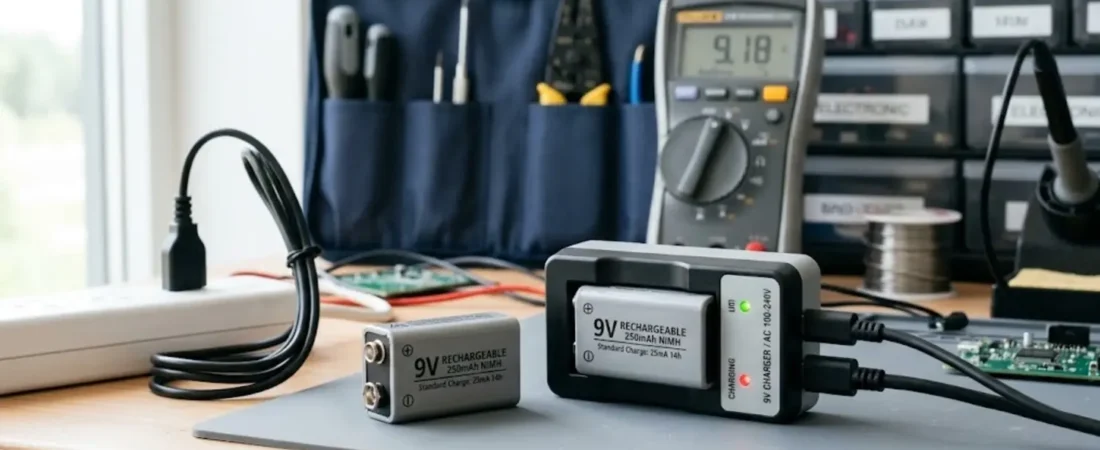
A rechargeable 9V battery can be a practical option for electronics that consume batteries regularly. Instead of discarding a depleted battery and buying another, you recharge a compatible model and use it again.
However, rechargeable 9V batteries are not all built the same way. Capacity ratings, chemistry, output voltage, charging methods, and compatibility can vary considerably. A battery that works well in one electronic device may be unsuitable for another.
This guide explains the main types of rechargeable 9V batteries, how to understand capacity labels, how charging works, and when a rechargeable battery makes sense.
What Is a Rechargeable 9V Battery?
A rechargeable 9V battery is designed to be charged and reused according to its manufacturer’s instructions. Traditional models often use nickel-metal hydride (NiMH) chemistry. Some newer products use lithium-based cells and internal electronics that regulate the output.
The familiar 9V shape does not tell you which chemistry is inside. Nor does it guarantee that the battery delivers a perfectly constant nine volts throughout its discharge cycle.
Always check the product label and specifications before choosing a battery or charger.
Types of Rechargeable 9V Batteries
1. NiMH rechargeable batteries
Nickel-metal hydride batteries are a common rechargeable option. They require a charger designed for the relevant NiMH battery format.
Their advantages include reusability and availability in familiar 9V-style housings. However, the usable capacity can be lower than some users expect, and the output voltage profile differs from that of an alkaline battery.
For frequently used compatible electronics, a NiMH battery may help reduce disposable battery purchases.
2. Lithium-based rechargeable batteries
Some rechargeable 9V products use lithium-based cells inside the case. Depending on the design, they may contain voltage-conversion electronics, a USB charging interface, or a dedicated charging system.
The internal design affects output stability, capacity, charging time, and compatibility. Some regulated models aim to maintain a steady output for much of their usable charge, but their behavior depends on the product.
Use only the charger and cable specified by the manufacturer. Do not assume that every lithium-based 9V battery can be charged in a conventional NiMH charger.
Rechargeable 9V Battery vs. Disposable Battery
| Feature | Rechargeable 9V | Disposable 9V |
|---|---|---|
| Reuse | Designed for repeated charging | Intended for one-time use |
| Initial cost | Usually higher | Usually lower |
| Charging equipment | Required | Not required |
| Capacity and runtime | Depends on chemistry and model | Depends on chemistry and model |
| Storage behavior | May self-discharge during storage | Varies by chemistry and product |
| Best use | Frequently used compatible devices | Infrequent use or devices requiring a specified disposable battery |
A rechargeable model can save money over time, but only if it is compatible with the device and used often enough to justify the initial cost.
What Does mAh Mean on a Rechargeable 9V Battery?
Milliamp-hours (mAh) are commonly used to describe battery capacity. In simple terms, the figure indicates how much electric charge a battery can deliver under specified testing conditions.
A higher mAh number does not automatically mean a battery will last proportionally longer in every device. Results depend on discharge rate, cutoff voltage, temperature, battery design, and the way capacity was measured.
Voltage also matters. Two batteries with the same mAh rating may not deliver the same amount of energy if their voltage profiles differ. For meaningful comparisons, look for energy ratings in watt-hours (Wh) when available, along with the manufacturer’s test conditions.
Be cautious with unusually large capacity claims on small 9V-format products. Compare the specifications with established manufacturers and independent tests when possible.
How to Charge a Rechargeable 9V Battery
The correct procedure depends on the battery design. Follow the manufacturer’s instructions rather than using a generic charging method.
- Identify the chemistry. Check whether the battery is NiMH, lithium-based, or another rechargeable type.
- Use the correct charger. A charger designed for one chemistry may be unsuitable for another.
- Inspect the battery. Do not charge a battery that is swollen, damaged, leaking, or unusually hot.
- Charge in suitable conditions. Use the temperature range and charging environment specified by the manufacturer.
- Monitor charging as directed. Do not ignore warnings, unusual heat, or damage to the charging cable or port.
- Store it properly. Once charging is complete, follow the manufacturer’s storage guidance.
Do not attempt to recharge disposable alkaline, zinc-carbon, or primary lithium batteries. They are not designed for routine recharging.
How Long Does Charging Take?
Charging time depends on battery capacity, the charger’s output, the battery’s charging circuitry, its remaining charge, and the charging method.
A USB rechargeable model with built-in control electronics may charge differently from a NiMH battery in a dedicated charger. Therefore, there is no single charging time that applies to all rechargeable 9V batteries.
Use the time or indicator specified by the manufacturer. If a battery becomes excessively hot or behaves abnormally, stop charging and consult its documentation.
How Long Does a Rechargeable 9V Battery Last?
There are two different questions: how long it runs per charge and how many recharge cycles it can handle over its useful life.
Runtime per charge depends on capacity, load, output voltage, device efficiency, and cutoff behavior. A high-drain device may deplete a battery much faster than a low-drain device.
Rechargeable lifespan depends on chemistry, charging practices, temperature, storage, and how deeply the battery is discharged. No single cycle count applies to every model.
For best results, avoid extreme temperatures, use the proper charger, and follow the manufacturer’s instructions about storage and charging.
Is a Rechargeable 9V Battery Suitable for Every Device?
No. The battery must meet the device’s requirements for voltage, format, current delivery, and chemistry.
Some electronics work well with compatible rechargeable batteries. Others may display a low-battery warning earlier than expected because rechargeable and alkaline batteries have different voltage profiles.
Smoke alarms deserve special care. Some models prohibit rechargeable batteries or list only approved replacement types. Never install a rechargeable battery in a smoke alarm unless the exact alarm manufacturer’s documentation explicitly permits it.
For general background on 9V battery formats, see our 9V battery guide.
When Does a Rechargeable 9V Battery Make Sense?
A rechargeable battery is worth considering when a compatible device uses batteries frequently. Examples may include some audio equipment, test instruments, and electronic projects, provided the manufacturers permit the chosen battery.
For a device that consumes very little power and sits unused for long periods, a suitable disposable battery may be simpler. Self-discharge and storage behavior can affect whether a rechargeable model is practical.
Calculate the total cost rather than comparing purchase prices alone. Include the battery, charger, electricity, replacement frequency, and expected useful life.
Common Mistakes to Avoid
- Assuming all 9V rechargeable batteries use the same chemistry.
- Choosing a charger based only on the battery’s shape.
- Treating mAh as a guarantee of runtime.
- Recharging a disposable battery.
- Using rechargeable batteries in equipment that prohibits them.
- Leaving batteries in extreme heat or storing them against metal objects.
- Ignoring damage, unusual heat, swelling, or other warning signs.
Avoiding these mistakes can help protect both the device and the battery.
Frequently Asked Questions
Are rechargeable 9V batteries worth buying?
They can be worthwhile for compatible devices that use batteries regularly. The value depends on purchase price, charger cost, runtime, and how often the battery is used.
Can I use any 9V charger?
No. The charger must support the battery’s chemistry and charging method. Follow the battery manufacturer’s instructions.
Does a higher mAh rating always mean longer runtime?
No. Capacity depends on test conditions, discharge rate, cutoff voltage, and battery design. The device’s power consumption also matters.
Can rechargeable 9V batteries be used in smoke alarms?
Only when the exact alarm manufacturer explicitly permits the particular rechargeable battery. Some models prohibit them, so always check the manual.
How should I store a rechargeable 9V battery?
Follow the manufacturer’s recommendations for temperature and charge level. Keep the battery protected from conductive objects and inspect it before use.
Final Thoughts
A rechargeable 9V battery can be convenient and economical when the device supports it and the battery is charged correctly. Before buying, compare chemistry, capacity, charging requirements, and voltage behavior instead of focusing only on the printed mAh number.
Choose a reputable product, use the specified charger, and follow the device manufacturer’s compatibility guidance. These steps will help you get more reliable use from your rechargeable battery.