
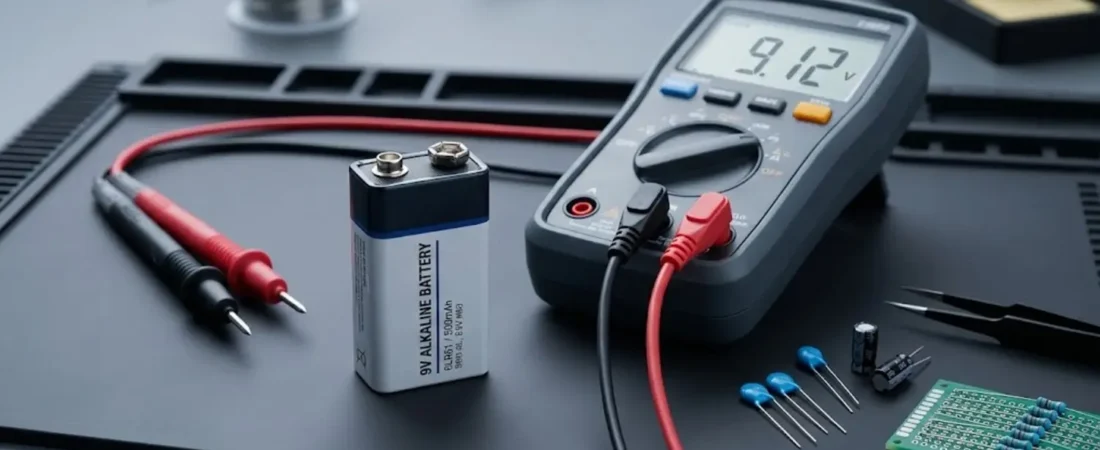
A 9V battery is a compact power source used in smoke alarms, multimeters, portable electronics, test equipment, and various household devices. Its rectangular shape and two snap-style terminals make it easy to recognize, but not every 9V battery offers the same performance.
Some are designed for everyday use, while others prioritize long storage life, reliable output, or repeated recharging. Choosing the right one depends on the device, how much power it draws, how often it is used, and the battery chemistry recommended by its manufacturer.
This guide explains how 9V batteries work, the main types available, common applications, battery life, and the details worth checking before buying a replacement.
What Is a 9V Battery?
A 9V battery is a battery designed to provide a nominal voltage of approximately nine volts. The familiar rectangular battery often has a snap connector on top, with two terminals that connect to a compatible device.
The term “9V” describes the battery’s nominal voltage, not its capacity or expected operating time. Two batteries marked 9V can have different internal chemistries, capacities, discharge characteristics, and storage lives.
A typical consumer 9V battery is often identified by labels such as 6LR61, 6F22, or PP3, depending on its chemistry and naming convention. These labels are related to battery format and type, but they should not be treated as a guarantee that every product is interchangeable in every device.
Before replacing a battery, check the device manual or the marking inside its battery compartment.
Main Types of 9V Batteries
The most common options include alkaline, lithium, rechargeable nickel-metal hydride (NiMH), and some lower-cost zinc-carbon batteries.
1. Alkaline 9V Batteries
Alkaline batteries are a common choice for household electronics. They are generally sold as single-use batteries, so they are replaced rather than recharged.
Their advantages include wide availability, straightforward replacement, and compatibility with many devices designed for standard 9V alkaline batteries.
Performance depends on the device’s power demand. A battery powering a low-drain device may last much longer than one used in equipment that draws substantial current. Temperature, storage conditions, and the battery’s age can also affect results.
Alkaline batteries are a practical option when a device manufacturer specifies them and regular replacement is acceptable.
2. Lithium 9V Batteries
Lithium 9V batteries are designed for applications where factors such as lower weight, long storage life, temperature performance, or extended operation matter. However, “lithium” does not automatically mean rechargeable.
Some consumer lithium 9V batteries are primary batteries intended for one-time use. Other products use rechargeable lithium-based cells and internal electronics, which can behave differently from conventional alkaline batteries.
Check the exact product specifications rather than relying on the word “lithium” alone.
For a closer look at the differences, read our guide to 9V lithium battery options and their advantages.
3. Rechargeable 9V Batteries
Rechargeable 9V batteries can be reused with a compatible charger. Many traditional rechargeable models use nickel-metal hydride chemistry, while newer products may use lithium-based cells and built-in voltage-conversion electronics.
Their benefits include reduced need to buy replacement batteries and the ability to recharge them repeatedly. Their limitations can include lower capacity than expected, self-discharge during storage, charger requirements, and differences in output voltage.
Rechargeable batteries are not automatically suitable for every device. Always check the equipment manufacturer’s instructions, particularly for smoke alarms and other safety-critical products.
Our detailed guide to rechargeable 9V battery capacity and charging explains what to compare.
4. Zinc-Carbon 9V Batteries
Zinc-carbon batteries are generally a budget-oriented option. They can be suitable for some low-drain devices, provided the equipment manufacturer permits them.
They may not perform as well as alkaline or suitable lithium alternatives under heavier loads. For devices that must remain dependable for long periods, such as safety equipment, follow the specified battery type rather than choosing only by price.
9V Battery Comparison
| Battery type | Rechargeable? | Main consideration |
|---|---|---|
| Alkaline | No | Widely available for compatible everyday devices |
| Primary lithium | No | Often offers long storage life and good performance in specified conditions |
| NiMH rechargeable | Yes | Requires a compatible charger and has chemistry-specific voltage characteristics |
| Rechargeable lithium-based | Yes | May include internal electronics; specifications vary by product |
| Zinc-carbon | No | Budget option for compatible low-drain devices |
This comparison is a general guide. Actual runtime and suitability depend on the exact battery model and the device.
What Devices Use 9V Batteries?
Smoke alarms
Some smoke alarms use replaceable 9V batteries, while others use different battery formats or sealed long-life power sources. The correct battery depends on the exact alarm model.
Never assume that every 9V battery chemistry is acceptable for every smoke alarm. Check the alarm’s label and manual before replacing its battery.
For device-specific guidance, see our guide to selecting the right battery for your smoke alarm.
Digital multimeters
Many digital multimeters use 9V batteries to power their display and measurement circuits. A suitable battery can provide convenient portable operation, but runtime depends on the meter’s design, display, backlight, and usage.
If readings become unstable or the meter displays a low-battery warning, consult its manual and replace the battery with the specified type.
Portable audio and electronic equipment
Some guitar pedals, microphones, small audio devices, and other electronics use 9V batteries. In these applications, output stability and current demand may matter as much as the battery’s nominal voltage.
Musicians and technicians should check the device’s current requirements before switching from a disposable battery to a rechargeable model.
Other household and technical devices
Certain test instruments, toys, sensors, and older electronic products also use 9V batteries. Always verify the battery compartment markings because similar-looking devices may require different formats.
How Long Does a 9V Battery Last?
There is no single runtime that applies to all 9V batteries. A battery may operate a low-power device for a long period but run down much faster in equipment that draws more current.
Battery life is influenced by several factors:
- Capacity: The amount of energy a battery can deliver under specified test conditions.
- Current demand: Devices that draw more current usually consume stored energy faster.
- Usage pattern: Continuous operation differs from occasional use.
- Temperature: Very hot or cold conditions can affect battery performance.
- Battery age: A battery stored for years may not perform like a fresh one.
- Device cutoff voltage: Some electronics stop working when the voltage falls below a particular level, even if some energy remains.
Manufacturer runtime claims are useful only when the test conditions resemble your actual application. A rating from one device should not be used to predict runtime in another.
What Does Battery Capacity Mean?
Battery capacity is commonly expressed in milliamp-hours (mAh), but this figure needs context. Capacity depends on discharge rate, cutoff voltage, temperature, and the testing method.
For that reason, comparing two batteries solely by their printed mAh ratings can be misleading. A rechargeable battery’s voltage behavior may also differ from that of an alkaline battery as it discharges.
For a useful comparison, check the technical data sheet, the specified load, and any runtime tests relevant to your device.
How to Choose the Right 9V Battery
Start with the equipment manual. Confirm the required voltage, battery format, chemistry, and any restrictions.
Next, consider how the device is used. For occasional use, a suitable disposable battery may be convenient. For frequently used equipment, a rechargeable model may reduce replacement purchases if the device supports it.
Storage matters too. If you keep spare batteries for emergencies, review the manufacturer’s storage-life guidance and check expiration dates before use.
Finally, buy from a reputable seller. Avoid damaged packages, corroded terminals, and batteries with unclear specifications.
Safe Handling and Storage
Keep batteries away from young children and store them in a cool, dry place within the manufacturer’s recommended temperature range. Do not carry loose batteries with metal objects that could bridge their terminals.
Never attempt to recharge a battery labelled for single use. Do not mix old and new batteries or different chemistries in equipment designed to use multiple cells. Follow local guidance for battery recycling and disposal.
If a battery leaks, becomes unusually hot, or shows physical damage, stop using it and follow the manufacturer’s safety instructions.
Frequently Asked Questions
Is every 9V battery the same size?
Many consumer 9V batteries use a familiar rectangular format, but labels, chemistry, terminal arrangement, and internal design can vary. Confirm the required format in the device manual.
Can I replace an alkaline 9V battery with a lithium one?
Only when the device manufacturer permits the specific lithium battery type. Nominal voltage alone does not establish compatibility.
Are rechargeable 9V batteries worth it?
They can be useful in frequently used compatible devices. Consider purchase cost, charger cost, capacity, self-discharge, and whether the device supports rechargeable batteries.
Can I use a rechargeable 9V battery in a smoke alarm?
Do not assume that you can. Some alarms explicitly prohibit rechargeable batteries or specify approved battery models. Follow the instructions for your exact alarm.
Why does a new 9V battery show less than 9 volts?
The reading depends on battery chemistry, condition, meter accuracy, and whether the measurement is taken under load. A voltage reading alone does not always reveal the battery’s remaining capacity.
Final Thoughts
The best 9V battery is the one that matches the device’s requirements and the way you use it. Alkaline, lithium, rechargeable, and zinc-carbon batteries each have different strengths, so compare the actual specifications rather than choosing by label or price alone.
For dependable results, check the equipment manual, buy fresh batteries from reputable sources, and replace them when required. This is especially important for safety equipment, where the correct battery type and proper testing matter more than convenience.