
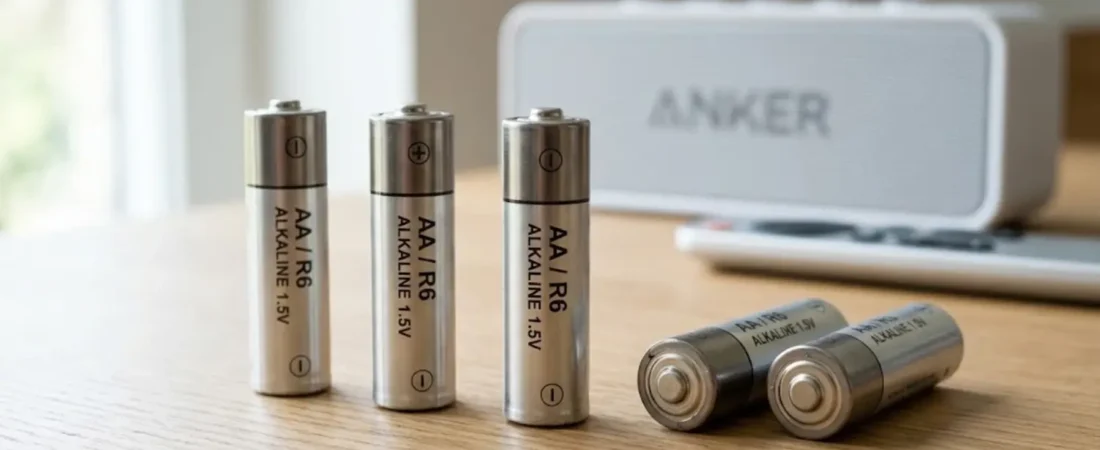
The AA battery is one of the most familiar battery sizes used in everyday electronics. From remote controls and wall clocks to flashlights, toys, cameras, and wireless accessories, AA batteries power a wide range of household and portable devices.
However, an AA battery is not a single type of battery. The term AA primarily describes the physical size and format of the cell. The chemistry inside the battery determines characteristics such as voltage, capacity, rechargeability, discharge behavior, and storage performance.
For example, a typical alkaline AA battery has a nominal voltage of 1.5 volts, while a rechargeable nickel-metal hydride (NiMH) AA battery normally has a nominal voltage of 1.2 volts. Both are AA batteries, but their electrical characteristics are different.
Understanding those differences makes it easier to choose the right battery, avoid compatibility problems, and get better performance from battery-powered devices.
What Is an AA Battery?
An AA battery is a cylindrical battery manufactured to a standardized physical size commonly used in portable electronics.
The important distinction is that AA describes the battery format rather than its chemistry.
AA batteries can be made using several different chemistries, including:
- Alkaline
- Nickel-metal hydride (NiMH)
- Zinc-carbon
- Lithium-based primary chemistry
- Other specialized chemistries
Because different chemistries can use the same AA form factor, two AA batteries may have different voltage ratings and performance characteristics.
When buying replacement batteries, therefore, do not look only for the letters “AA.” Check the battery chemistry and the requirements of the device as well.
What Voltage Is an AA Battery?
A typical alkaline AA battery has a nominal voltage of 1.5 volts.
A rechargeable NiMH AA battery normally has a nominal voltage of 1.2 volts.
These numbers are nominal ratings rather than fixed voltages. The actual voltage of a battery changes as it is charged, discharged, and placed under different loads.
A fresh battery can also show a different voltage when measured with a multimeter without a device connected.
For a more detailed explanation, see our guide to understanding AA battery voltage and how it changes.
Common Types of AA Batteries
Alkaline AA Batteries
Alkaline batteries are among the most widely available AA batteries.
They are disposable and can be purchased from supermarkets, electronics stores, convenience stores, and online retailers.
Typical uses include:
- Remote controls
- Wall clocks
- Flashlights
- Toys
- Wireless accessories
- Household electronics
Their main advantage is convenience. They are ready to use and do not require a charger.
Their limitation is that conventional alkaline batteries are designed for single use rather than repeated charging.
Rechargeable NiMH AA Batteries
Nickel-metal hydride batteries are one of the most common rechargeable AA options.
A NiMH AA battery generally has a nominal voltage of 1.2 volts and can be recharged using a compatible charger.
They can be particularly useful in devices that consume batteries frequently. Instead of repeatedly purchasing disposable cells, users can recharge the same batteries and put them back into service.
Game controllers, flashlights, cameras, and other frequently used electronics are examples where rechargeable AA batteries can be practical.
Lithium AA Batteries
Lithium-based primary batteries are also available in AA formats.
Depending on the specific product, they can offer characteristics such as low weight, long storage life, or useful performance in certain temperature conditions.
However, the phrase “lithium AA” should not automatically be treated as meaning a rechargeable lithium-ion battery.
Lithium battery technologies have different electrical characteristics, so always check the manufacturer’s specifications before using one in a device.
AA Battery Capacity Explained
Battery capacity is commonly expressed in milliamp-hours (mAh).
The capacity provides an indication of how much electrical charge a battery can deliver under specified testing conditions.
It is tempting to assume that a battery with a higher mAh rating will always last longer, but real-world runtime is more complicated.
A device’s power consumption has a major effect.
A low-power wall clock may operate for a long period from an AA battery, while a high-drain flashlight can consume a battery much faster.
Battery chemistry, discharge rate, temperature, internal resistance, and the device’s voltage requirements can also affect usable capacity.
For rechargeable batteries, the manufacturer’s stated capacity is useful for comparison, but it should not be interpreted as a guaranteed number of hours.
How Long Does an AA Battery Last?
There is no universal AA battery lifespan.
The same battery can provide very different runtimes in different devices.
A basic remote control might use relatively little energy, while a motorized toy or high-output flashlight can draw much more current.
Factors affecting runtime include:
- Battery chemistry
- Capacity
- Device power consumption
- Usage frequency
- Temperature
- Battery age
- Storage conditions
- Internal resistance
- Device cutoff voltage
Our guide to the factors that affect AA battery life goes into more detail about calculating and improving runtime.
Battery Capacity vs Battery Life
Capacity and battery life are connected, but they are not the same thing.
Capacity describes the amount of charge a battery can provide under defined conditions.
Battery life describes how long that battery actually powers a particular device.
A simple theoretical estimate can be made with:
Runtime ≈ Battery Capacity ÷ Average Current Draw
For example, if a battery has a rated capacity of 2,000 mAh and a device draws 100 mA continuously:
2,000 ÷ 100 = 20 hours
This is only a theoretical calculation. Real-world runtime can be lower because batteries do not necessarily deliver their full rated capacity at every discharge rate.
The device may also have a minimum operating voltage that causes it to stop working before the battery is completely discharged.
Alkaline vs Rechargeable AA Batteries
Disposable alkaline and rechargeable NiMH batteries have different strengths.
| Feature | Alkaline AA | Rechargeable NiMH AA |
|---|---|---|
| Typical nominal voltage | 1.5V | 1.2V |
| Rechargeable | No | Yes |
| Charger required | No | Yes |
| Initial cost | Usually lower | Usually higher |
| Repeated use | No | Yes |
| Best suited to | Occasional use | Frequent use |
Neither option is automatically better for every situation.
If you only use AA batteries occasionally, disposable alkaline cells may be convenient.
If you regularly replace batteries in controllers, flashlights, toys, or other devices, rechargeable NiMH cells may make more sense.
Always check whether the device is compatible with rechargeable batteries before making the switch.
Are Rechargeable AA Batteries Safe?
Rechargeable AA batteries can be safely used when they are compatible with the device and charged correctly.
For NiMH batteries, use a charger designed for NiMH cells.
Do not place ordinary disposable alkaline batteries into a charger. Standard alkaline batteries are not designed for repeated charging and can leak or otherwise fail if charged improperly.
It is also important to stop using batteries that are visibly damaged, leaking, or otherwise deteriorated.
Can You Mix AA Batteries?
It is generally best to avoid mixing batteries in a multi-cell device.
Do not combine batteries that differ significantly in:
- Age
- Chemistry
- Capacity
- Charge state
- Brand or model characteristics
For devices that require two or more batteries, using a matched set is a better approach.
When batteries have different characteristics, they can discharge unevenly. The weaker cell can become depleted sooner and affect the performance of the entire device.
How Should AA Batteries Be Stored?
Store unused batteries according to the manufacturer’s recommendations.
A cool, dry environment is generally preferable to excessive heat or moisture.
Avoid keeping loose batteries in a container with keys, coins, or other metal objects. If conductive objects connect the terminals, the battery can short circuit.
For electronics that will not be used for a long time, check the manufacturer’s storage instructions. In some cases, removing disposable batteries can help reduce the risk of damage from leakage.
Why Do AA Batteries Leak?
Battery leakage can occur when the internal materials of a cell deteriorate and escape from the battery casing.
Age, heat, storage conditions, and prolonged installation can contribute to leakage.
If a battery is leaking, do not continue using it. Avoid unnecessary contact with the leaked material and follow appropriate battery disposal and cleanup guidance for the affected device.
The best way to reduce the risk is to avoid keeping old batteries installed in equipment indefinitely.
AA Battery Applications
AA batteries remain popular because they provide a useful combination of size, availability, and energy storage.
Remote Controls
Many household remote controls use AA batteries because they are inexpensive and easy to replace.
Wall Clocks
Low-power clocks can operate for long periods because their energy requirements are relatively small.
Flashlights
AA-powered flashlights are common for household, emergency, and outdoor use.
Toys
Toys may use AA cells to power lights, sounds, motors, and other electronic functions.
Wireless Accessories
Some keyboards, mice, controllers, and other wireless accessories use AA batteries.
Cameras and Other Electronics
Certain cameras and specialized electronic equipment also use AA cells.
Always follow the battery requirements provided by the manufacturer rather than relying only on the physical size of the compartment.
AA vs AAA Batteries
AA and AAA batteries are similar in their general purpose but differ in physical size.
AA batteries are larger than AAA batteries and can generally accommodate more active material within the cell.
Both standard alkaline AA and AAA batteries typically have a nominal voltage of 1.5 volts. Rechargeable NiMH versions of both sizes are commonly rated at 1.2 volts.
The correct size is determined by the device.
Never replace an AAA battery with an AA battery simply because both have similar voltage characteristics. The physical design of the battery compartment and the electrical requirements both matter.
Common AA Battery Mistakes
Assuming Every AA Battery Is 1.5V
The AA designation refers primarily to size. Chemistry determines the nominal voltage.
Choosing a Battery Only by mAh
Capacity matters, but actual runtime also depends on the device and operating conditions.
Using a Battery That Fits but Has the Wrong Voltage
Physical compatibility does not guarantee electrical compatibility.
Mixing Different Batteries
Different cells can discharge unevenly and cause poor performance.
Charging Disposable Batteries
Ordinary alkaline batteries are not designed for repeated charging.
Leaving Batteries in Unused Electronics
Long-term storage can increase the consequences of battery leakage.
How to Choose the Right AA Battery
Start with the device rather than the battery aisle.
Check:
- Required battery size
- Recommended chemistry
- Voltage requirements
- Rechargeable-battery compatibility
- Expected power consumption
- Operating conditions
Then consider your usage pattern.
For occasional household use, alkaline batteries may be convenient.
For equipment that consumes batteries regularly, rechargeable NiMH cells can be a practical alternative.
The best choice is not simply the battery with the highest capacity or lowest price. It is the battery that matches the device and your usage needs.
Frequently Asked Questions
Is an AA battery always 1.5V?
No. A typical alkaline AA battery is 1.5V nominal, while a typical rechargeable NiMH AA battery is 1.2V nominal.
Are AA batteries rechargeable?
Some are. NiMH AA batteries are designed to be rechargeable, while ordinary alkaline AA batteries are generally disposable.
How long does an AA battery last?
Runtime depends on the battery, device, power consumption, temperature, battery condition, and usage pattern.
What does mAh mean?
mAh means milliamp-hours and is commonly used to describe battery capacity under specified testing conditions.
Can I mix AA batteries?
It is better to use a matched set rather than combining batteries with different ages, chemistries, capacities, or charge levels.
Can rechargeable AA batteries be used in every device?
No. Check the device manufacturer’s instructions before replacing disposable batteries with rechargeable cells.
Conclusion
AA batteries may look simple, but the technology behind them varies considerably.
The AA designation primarily identifies the battery’s physical format. Alkaline, NiMH, and other AA batteries can have different voltage characteristics, capacity, discharge behavior, and intended uses.
For the best results, choose a battery based on the manufacturer’s requirements and the way you use the device. Understanding the difference between voltage, capacity, chemistry, and runtime will help you avoid common battery mistakes and get more dependable performance.