
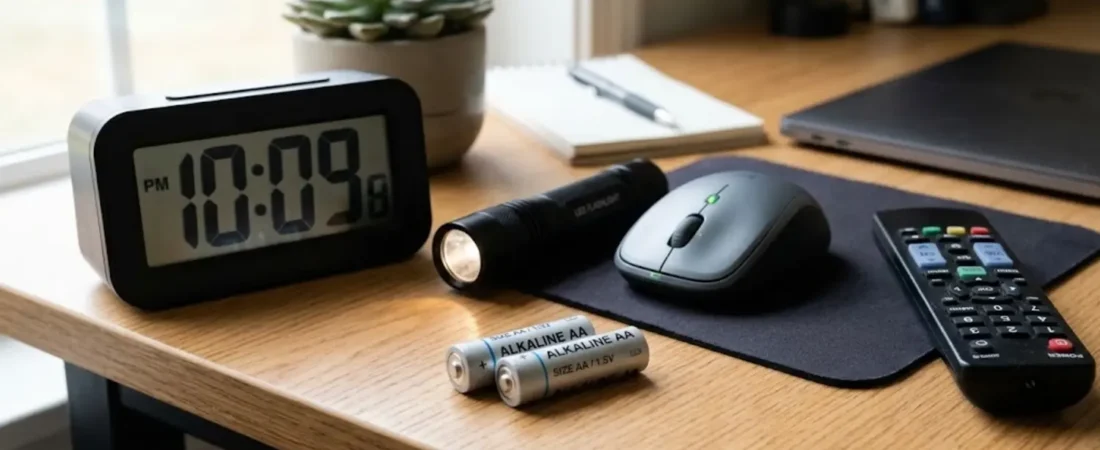
There is no single answer because AA battery life depends on both the battery and the device using it.
An AA battery in a basic wall clock may operate for a long time because the clock uses relatively little energy. The same battery in a high-output flashlight, motorized toy, or other demanding device can run down much faster.
Battery chemistry, capacity, current demand, temperature, age, storage conditions, and the device’s own design all influence practical runtime.
This is why a battery’s printed mAh rating cannot be converted directly into a guaranteed number of hours.
What Determines AA Battery Life?
Several factors determine how long an AA battery remains useful.
The most important include:
- Battery chemistry
- Capacity
- Device power consumption
- Usage frequency
- Temperature
- Battery age
- Storage conditions
- Internal resistance
- Device cutoff voltage
The relationship between these factors explains why the same battery can perform very differently in two devices.
Battery Chemistry Matters
AA batteries are available in several chemistries, and each behaves differently.
Alkaline batteries are common disposable cells.
NiMH batteries are widely used as rechargeable AA batteries.
Lithium-based primary AA batteries are also available for certain applications.
Each chemistry has different voltage characteristics, discharge behavior, capacity, and storage properties.
As a result, two batteries with the same physical size can provide different practical runtimes.
How Does Battery Capacity Affect Runtime?
Battery capacity is commonly measured in milliamp-hours (mAh).
In general, capacity gives an indication of how much electrical charge a battery can provide under specified test conditions.
A higher capacity can contribute to longer runtime when comparing otherwise similar batteries in the same application.
However, mAh is not a guarantee.
The device determines how quickly that available energy is consumed.
For example, a device drawing 50 mA and another drawing 500 mA place very different demands on the same battery.
The second device can deplete the battery much faster.
How to Estimate AA Battery Runtime
A basic theoretical calculation is:
Runtime ≈ Battery Capacity ÷ Average Current Draw
Suppose a rechargeable AA battery is rated at 2,000 mAh and a device draws an average of 100 mA.
The calculation would be:
2,000 ÷ 100 = 20 hours
That result should not be interpreted as a guaranteed 20-hour runtime.
Real batteries may deliver less than their rated capacity under particular discharge conditions. The device may also stop operating when voltage falls below its required level.
Temperature, internal resistance, battery age, and current demand can further change the result.
Use the formula as a rough estimate rather than a promise.
How Long Do Alkaline AA Batteries Last?
An alkaline AA battery can last for very different periods depending on its application.
A low-power device may use an alkaline cell for a long time.
A high-drain device can consume the same type of battery much faster.
For example, a wall clock typically requires very little power compared with a high-output flashlight.
This is why generic statements such as “an AA battery lasts X hours” are usually misleading without specifying the device and operating conditions.
How Long Do Rechargeable AA Batteries Last?
Rechargeable AA batteries have two different measures of useful life.
The first is runtime per charge.
This describes how long the battery powers a device after being fully charged.
The second is cycle life.
This describes how many charge and discharge cycles the battery can complete before its usable capacity declines significantly.
A rechargeable battery may therefore provide several hours of runtime on one charge while remaining useful through many charging cycles.
The actual performance depends on the battery model, charger, device, charging conditions, and how deeply the battery is discharged.
AA Battery Life in Low-Power Devices
Low-power electronics generally place less demand on AA batteries.
Examples include:
- Wall clocks
- Basic remote controls
- Some sensors
- Certain wireless accessories
Because these devices consume relatively little energy, an AA battery may remain useful for a long period.
That does not mean every low-power device will produce the same runtime. Different electronics can have different standby consumption, operating cycles, and voltage requirements.
AA Battery Life in High-Drain Devices
High-drain equipment can consume batteries much more quickly.
Examples include:
- High-output flashlights
- Motorized toys
- Some cameras
- Game controllers
- Devices containing motors or powerful lights
These products can draw substantially more current than a simple clock or remote control.
The battery’s chemistry and ability to deliver current can therefore become more important in high-drain applications.
Why Can Two AA Batteries Have Different Runtimes?
Two AA batteries may appear almost identical while producing different results.
Capacity
One battery may have more usable capacity than another.
Chemistry
Alkaline and NiMH batteries have different discharge characteristics.
Age
Older batteries may have reduced performance.
Storage
Exposure to unsuitable temperatures or poor storage conditions can affect battery condition.
Internal Resistance
Internal resistance influences how well a battery can deliver current, especially when the device demands more power.
Temperature
Battery performance can change significantly in very cold or hot conditions.
Device Cutoff Voltage
Different devices may stop operating at different battery voltages.
Does a Higher mAh Rating Always Mean Longer Battery Life?
Not necessarily.
If two comparable batteries are used in the same device under similar conditions, the higher-capacity battery will generally have the potential to provide more runtime.
But battery capacity is only one part of the equation.
Different chemistry, discharge rate, temperature, internal resistance, and device behavior can change the result.
For this reason, comparing batteries solely by the largest number printed next to “mAh” can lead to unrealistic expectations.
Does AA Battery Voltage Affect Battery Life?
Voltage and runtime are related to the overall electrical system, but a higher nominal voltage does not automatically mean longer battery life.
For example, alkaline AA batteries are generally rated at 1.5V nominal, while NiMH rechargeable AA batteries are generally rated at 1.2V nominal.
That difference alone does not determine which battery will run a device longer.
The device’s design, battery capacity, discharge characteristics, and operating requirements all matter.
Our guide to AA battery voltage and its behavior during discharge explains this distinction in more detail.
How Temperature Affects AA Battery Life
Temperature can have a noticeable effect on battery performance.
Cold conditions can make it harder for some battery chemistries to deliver current effectively.
High temperatures can accelerate aging and may affect storage life.
The ideal temperature range varies by chemistry and manufacturer, so check the battery specifications if you are using cells in unusually hot or cold environments.
Does Battery Age Reduce Runtime?
Yes.
Batteries can lose performance as they age.
Disposable batteries can be affected by long storage periods and unsuitable storage conditions.
Rechargeable batteries also gradually lose capacity as they age and complete charging cycles.
Consequently, a battery that once provided excellent runtime may eventually power the same device for a shorter period.
Does Leaving AA Batteries in a Device Affect Their Life?
It can.
Some electronics continue drawing a small amount of power even when they appear to be switched off.
There is also a separate concern: leakage.
If a battery-powered device will remain unused for an extended period, check the manufacturer’s storage recommendations. For some devices, removing disposable batteries can reduce the potential consequences of leakage.
How to Make AA Batteries Last Longer
You cannot increase the amount of energy physically stored in a battery, but you can reduce unnecessary consumption.
Turn Devices Off
If the device continues drawing power when not needed, switching it off can help conserve energy.
Use Sleep Modes
Many modern electronic devices include automatic sleep features. Using them can reduce unnecessary power consumption.
Choose a Suitable Battery
Use the chemistry recommended by the equipment manufacturer.
Avoid Extreme Temperatures
Keeping batteries within their recommended operating range can support more consistent performance.
Use Matched Battery Sets
If a device uses multiple batteries, use cells with similar age, type, and charge state.
Store Spare Batteries Properly
Protect battery terminals and keep unused cells in suitable storage conditions.
How Can You Tell an AA Battery Is Running Low?
The signs vary by device.
You may notice:
- A flashlight becoming dimmer
- A motor slowing down
- A remote becoming less responsive
- A wireless accessory disconnecting
- A low-battery warning
- A toy behaving inconsistently
Some electronics shut down automatically once the battery voltage reaches the device’s minimum operating threshold.
Can a Multimeter Tell You How Much Battery Life Remains?
A multimeter can measure voltage, but it cannot reliably tell you exactly how many hours of runtime remain.
An open-circuit measurement is useful for checking battery voltage, but it does not reproduce the load imposed by the actual device.
A weak battery can sometimes show a reasonable voltage when disconnected and then experience a significant voltage drop when current is drawn.
For this reason, voltage testing is useful for diagnosis but should not be treated as a precise remaining-runtime measurement.
How Long Do AA Batteries Last in a Flashlight?
Flashlight runtime depends heavily on the flashlight itself.
A small flashlight running at low brightness may consume considerably less energy than a high-output model operating at maximum brightness.
Battery chemistry, capacity, brightness setting, temperature, and flashlight electronics all influence runtime.
When available, the manufacturer’s runtime figures for a particular flashlight are more useful than a generic AA battery estimate.
How Long Do AA Batteries Last in a Remote?
Remote controls generally consume relatively little power compared with high-drain electronics.
As a result, AA batteries can often remain useful for a long period in compatible remotes.
However, usage frequency still matters. A remote used dozens of times every day naturally consumes more energy than one used occasionally.
Battery chemistry and the design of the remote also affect runtime.
How Long Do AA Batteries Last in a Game Controller?
Game controllers can place a higher demand on AA batteries than basic remote controls.
Wireless communication, vibration motors, indicator lights, and other electronics can all contribute to power consumption.
Runtime therefore varies significantly between controller models and usage patterns.
For people who frequently use an AA-powered controller, rechargeable NiMH batteries can be a practical option because the cells can be charged and reused.
Rechargeable vs Disposable AA Battery Life
Disposable and rechargeable batteries should not be judged only by one discharge.
An alkaline AA battery is intended for single use.
A rechargeable NiMH AA battery is designed for repeated charging and use.
Even if a rechargeable cell provides a different runtime per charge compared with an alkaline battery, its ability to be reused can make it useful for people who frequently consume AA batteries.
The better option depends on how often the device is used and whether the device supports the chosen battery type.
AA Battery Storage and Long-Term Performance
Proper storage helps preserve battery condition.
Keep batteries in an environment recommended by the manufacturer and avoid excessive heat or moisture.
Do not store loose cells where their terminals can touch conductive metal objects such as coins or keys.
For equipment that will remain unused for a long time, follow the manufacturer’s storage instructions.
Common Mistakes That Reduce AA Battery Life
Using the Wrong Battery Type
A battery that is physically compatible may not be electrically or chemically appropriate.
Leaving High-Power Features On
Bright lights, motors, vibration, and wireless functions can increase energy consumption.
Mixing Old and New Batteries
Different battery conditions can cause uneven discharge.
Ignoring Temperature
Extreme temperatures can affect performance.
Poor Storage
Heat, moisture, and accidental short circuits can damage batteries or reduce their useful life.
Focusing Only on mAh
Capacity matters, but it does not determine runtime by itself.
Frequently Asked Questions
How long does an AA battery normally last?
There is no universal runtime. A low-power device may use an AA battery for a long period, while a high-drain device can deplete one much faster.
Do rechargeable AA batteries last as long as alkaline batteries?
Runtime per charge varies by battery and device. Rechargeable batteries have the additional benefit of being reusable.
Does higher mAh mean longer AA battery life?
A higher capacity can provide more runtime under comparable conditions, but actual performance depends on several other factors.
Why do AA batteries die faster in some devices?
Different devices consume different amounts of energy. High-drain equipment can use batteries much faster than low-power electronics.
Does temperature affect AA battery life?
Yes. Temperature can affect current delivery, battery performance, and aging.
Can AA battery runtime be calculated?
A rough estimate can be made by dividing capacity by average current draw, but real-world runtime can differ from the theoretical result.
Conclusion
AA battery life is determined by the interaction between the battery and the device.
Capacity, chemistry, current demand, temperature, age, storage conditions, and device design all influence how long a battery remains useful.
A battery that lasts for a long time in a wall clock may be depleted much faster in a powerful flashlight. That difference is expected because the devices place very different demands on the battery.
For dependable results, choose a battery compatible with the device, reduce unnecessary power consumption, store spare batteries correctly, and consider rechargeable AA cells when you regularly use battery-powered equipment.