
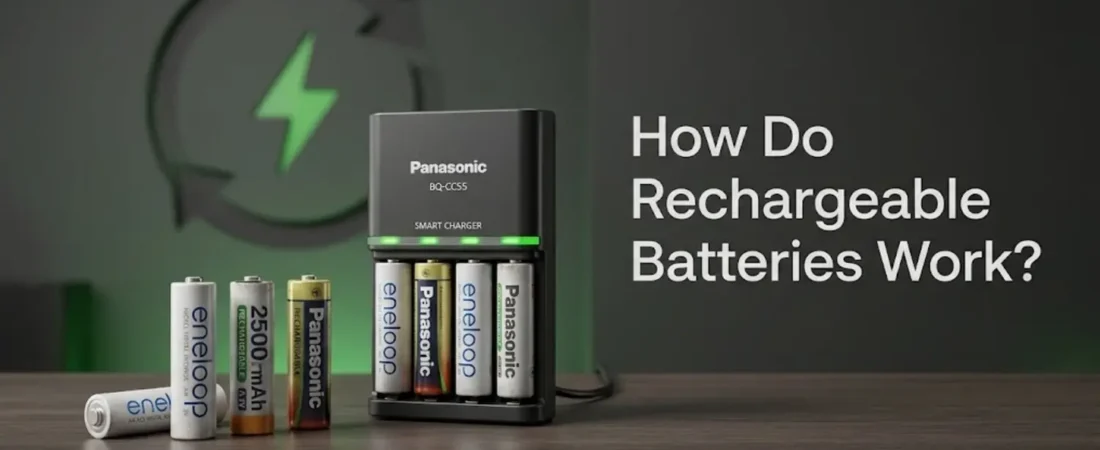
Rechargeable batteries power many of the devices people use every day, including wireless controllers, cameras, toys, flashlights, portable electronics, and cordless tools. Unlike a standard disposable battery, a rechargeable battery is designed to be used, recharged, and used again over multiple cycles.
The idea sounds simple: connect the battery to a charger, wait for it to recharge, and use it again. Behind that process, however, a series of chemical reactions allows the battery to store electrical energy and release it when a device needs power.
Understanding how rechargeable batteries work helps you choose the right type, avoid common charging mistakes, and get more useful service from your batteries. It also explains why rechargeable batteries do not all charge at the same speed or provide the same voltage and runtime.
What Is a Rechargeable Battery?
A rechargeable battery is an electrochemical energy-storage device designed so that its internal chemical reactions can be reversed, within specified limits, by applying an external electrical current.
When the battery powers a device, chemical energy is converted into electrical energy. When a compatible charger supplies electricity, the charging process drives the battery’s chemistry back toward its charged state.
A rechargeable battery is not necessarily suitable for every device. Different battery chemistries have different voltage characteristics, charging requirements, capacities, and safety limits. A battery and charger must be compatible with one another.
Common rechargeable battery types include:
- Nickel-metal hydride (NiMH): Frequently used in rechargeable AA and AAA batteries.
- Lithium-ion (Li-ion): Common in phones, laptops, cameras, and many portable electronics.
- Lithium iron phosphate (LiFePO4): Used in applications where its particular balance of durability, voltage, and safety characteristics is suitable.
- Lead-acid: Used in applications such as vehicle starting systems and backup power.
Each type works through its own chemistry, so the details of charging and discharging are not identical.
How Does a Rechargeable Battery Store Energy?
A rechargeable battery generally contains positive and negative electrodes, an electrolyte, and a separator. The electrodes participate in chemical reactions, the electrolyte allows ions to move inside the cell, and the separator helps prevent direct electrical contact between the electrodes while allowing the necessary ionic movement.
When a device draws power, chemical reactions create conditions that drive electrons through the external circuit. Those electrons travel through the device, supplying electrical energy to its components. Inside the battery, ions move through the electrolyte to maintain charge balance.
The exact materials and reactions depend on the battery chemistry. In a lithium-ion cell, for example, lithium ions move between the electrodes during charging and discharging. In a NiMH cell, different electrode materials and reactions are involved.
The key concept is that the battery does not simply hold electricity like a container holds water. It stores energy through chemical changes that can be reversed during charging, provided the battery is operated within its design limits.
What Happens When a Battery Is Charging?
Charging reverses the useful chemical changes that occurred while the battery supplied power. The charger provides electrical energy at a controlled voltage and current, encouraging ions and active materials to return toward their charged state.
The process usually involves several stages, although the exact method depends on the chemistry and charger design.
1. The charger checks and supplies power
A compatible charger supplies electricity according to the battery’s requirements. Some chargers identify the battery type or monitor its voltage and temperature. Smart charging systems may adjust the current as charging progresses.
A charger designed for one chemistry should not automatically be used with another. For example, NiMH and lithium-ion batteries require different charging control methods.
2. Chemical energy is restored
Electrical energy drives chemical reactions that restore the battery’s ability to deliver power. The ions move through the cell and the electrode materials return toward their charged condition.
This is why charging is more than simply connecting a battery to a power source. The current must be controlled so that the battery can accept energy safely and efficiently.
3. Charging slows, stops, or changes mode
Many rechargeable batteries do not accept power at the same rate throughout the entire charging process. Depending on the chemistry, the charger may reduce current, terminate charging when specific conditions are met, or use a maintenance strategy where permitted by the battery design.
A charging indicator turning green or showing 100% means the charger or device has reached its programmed completion condition. It does not mean the battery will hold its full original capacity forever.
How Does a Rechargeable Battery Release Energy?
When a charged battery is connected to a compatible device, the battery’s chemical reactions drive electrons through the external circuit. The device converts that electrical energy into the work it needs to perform, such as producing light, running a motor, recording a photograph, or powering a circuit board.
As energy is used, the battery’s state of charge decreases. Its voltage may also change during discharge, depending on chemistry and load.
A device with a high power demand can use stored energy quickly. A low-power device may operate for much longer with the same battery. That is why a rechargeable battery’s rated capacity cannot, by itself, predict runtime for every product.
For example, a rechargeable AA battery in a low-power remote control may last far longer between charges than the same battery in a toy with a motor. The battery is the same size, but the devices demand different amounts of energy.
What Is a Charging Cycle?
A charging cycle refers to the use and replenishment of a battery’s stored capacity. It does not always mean charging from completely empty to completely full in one session.
Imagine using about half of a battery’s available capacity, recharging it, and later using another half. In many battery-life calculations, that combined use is roughly equivalent to one full cycle, although manufacturers’ cycle-counting methods can differ.
Rechargeable batteries have a finite service life. With repeated use, their ability to store energy may gradually decline. Internal resistance can also increase, and the battery may eventually deliver less runtime or fail to meet the device’s requirements.
Cycle life varies with chemistry, design, operating temperature, depth of discharge, charging method, and how the battery is stored. There is no single cycle count that applies to all rechargeable batteries.
Why Do Rechargeable Batteries Have Different Voltages?
Nominal voltage comes from the battery’s chemistry and cell design. A standard rechargeable NiMH AA cell is commonly rated at 1.2 volts nominally, while a disposable alkaline AA battery is commonly labelled 1.5 volts nominally.
This difference does not automatically mean that the rechargeable battery is inferior. Voltage changes during use, and the device’s electrical design determines whether a particular battery is suitable.
Lithium-ion batteries use different nominal voltages again, and some products contain internal electronics to provide a particular output from a different internal cell voltage. Therefore, always check the specifications rather than assuming that similar-looking batteries are interchangeable.
For a related explanation of AA battery types and their intended use, read our guide to whether AA batteries are rechargeable.
Why Does a Rechargeable Battery Lose Capacity Over Time?
Rechargeable batteries experience gradual wear because their internal materials and interfaces change during use. The exact aging mechanisms vary by chemistry.
Common factors include:
- Repeated cycling: Charging and discharging cause gradual changes inside the cell.
- High temperatures: Heat can accelerate aging and may create safety risks.
- Incorrect charging: Using an unsuitable charger can damage the battery or create hazardous conditions.
- Long periods at unsuitable charge levels: Some chemistries age faster when stored under particular conditions.
- Physical damage: Crushing, puncturing, swelling, or other damage can make a battery unsafe.
A battery that once powered a device for ten hours may eventually provide only a fraction of that runtime. This decline is normal aging, although a sudden change can indicate damage, poor contact, a faulty charger, or a device problem.
How to Charge Rechargeable Batteries Safely
Safe charging begins with using the charger specified or approved by the battery manufacturer. Do not rely on the battery’s physical shape alone to determine compatibility.
Follow these precautions:
- Check the battery label and charger instructions before charging.
- Use the correct charger for the battery chemistry and model.
- Keep batteries away from excessive heat, moisture, and direct physical damage.
- Do not charge batteries that are leaking, swollen, cracked, or otherwise damaged.
- Stop using a battery if it becomes unusually hot, develops an unusual odor, or shows signs of damage.
- Keep loose batteries away from metal objects that could bridge their terminals.
- Follow the manufacturer’s storage and disposal instructions.
Do not try to recharge ordinary disposable alkaline, zinc-carbon, or other non-rechargeable batteries. Attempting to recharge a battery not designed for it can cause leakage, rupture, or other hazards.
Do Rechargeable Batteries Save Money?
They can, particularly when batteries are used frequently. A rechargeable battery has a higher initial cost and may require a suitable charger, but it can replace multiple disposable batteries over its useful life.
The actual savings depend on purchase price, how often the battery is used, its usable cycle life, charging costs, and how much capacity remains as it ages. If a device uses batteries only once in a long while, a disposable battery may be more convenient. For regularly used toys, controllers, flashlights, or other compatible devices, rechargeables may be more economical.
Environmental impact also depends on the battery’s materials, manufacturing, lifespan, and recycling. Reusing a battery many times can reduce the number of disposable cells needed, but batteries still require responsible end-of-life handling.
Final Thoughts
Rechargeable batteries work by storing energy through chemical reactions that can be reversed with a suitable charging process. During use, those reactions produce electrical energy; during charging, a compatible charger restores the battery’s stored energy within the limits of its design.
To get the best performance, choose the right chemistry for your device, use a compatible charger, avoid excessive heat, and replace batteries that show signs of damage or serious capacity loss. Rechargeable technology can provide convenience and long-term value, but only when the battery, charger, and device are used together as intended.