
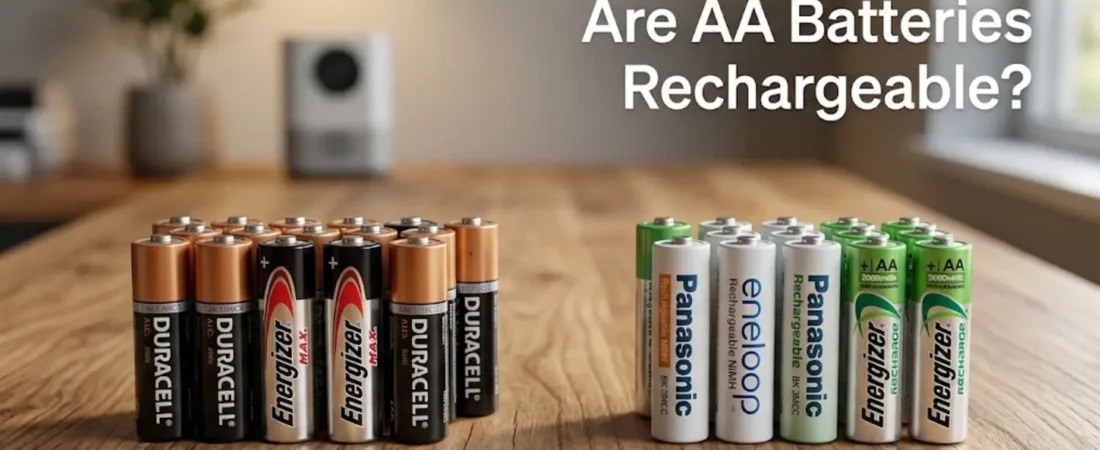
Yes, some AA batteries are rechargeable, but not all of them are. AA describes a battery’s physical size, not whether it can be charged again. Rechargeable AA batteries are commonly made with nickel-metal hydride (NiMH) chemistry, while many standard AA batteries sold for everyday household use are disposable alkaline cells.
This distinction matters because the two types may look similar but are designed to work differently. A rechargeable AA battery can be used repeatedly with a compatible charger, whereas a standard disposable alkaline battery should not be recharged. Attempting to charge a battery that is not designed for recharging can cause leakage, rupture, or other safety problems.
If you are deciding which type to buy, consider how often the device is used, its power requirements, the manufacturer’s battery recommendations, and whether the convenience of recharging outweighs the initial cost.
How Can You Tell If an AA Battery Is Rechargeable?
The safest way to identify a rechargeable AA battery is to read its label. Look for wording such as “rechargeable” or “NiMH,” along with charging instructions from the manufacturer.
A typical rechargeable NiMH AA battery has a nominal voltage of 1.2 volts. A standard disposable alkaline AA battery is generally labelled 1.5 volts nominally. This voltage difference is a useful clue, but it should not be your only test. Battery labels and specifications are more reliable than appearance alone.
Some rechargeable lithium-based AA-size products are also available. These can have different internal designs and output characteristics, including electronic regulation in certain models. They may require a specific charging method and should not be treated as interchangeable with ordinary NiMH cells.
Before charging any AA battery, check all of the following:
- The label explicitly identifies the battery as rechargeable.
- The battery chemistry is stated or otherwise clearly specified.
- The charger supports that exact battery type.
- The device manufacturer allows the battery type and voltage.
- The battery is not damaged, leaking, swollen, or unusually hot.
Do not attempt to identify a battery’s chemistry by opening it or by testing it with improvised charging equipment.
Which Types of AA Batteries Can Be Recharged?
Nickel-metal hydride (NiMH)
NiMH is one of the most common chemistries used in rechargeable AA batteries. These cells are widely used in compatible toys, wireless controllers, flashlights, cameras, and other devices.
A major advantage is reusability. Instead of discarding the cell after one discharge, you can recharge it using a compatible NiMH charger and use it again. The number of useful cycles depends on the product, charging conditions, depth of discharge, temperature, and age.
NiMH cells have a nominal voltage of around 1.2 volts, which is lower than the nominal voltage printed on many disposable alkaline AA batteries. Many devices work well with NiMH cells, but some equipment has specific voltage requirements. Always consult the manual before switching.
Rechargeable lithium-based AA-size batteries
Some products sold in AA form use lithium-based technology. Their internal design and output voltage vary. Certain products include electronics to provide a regulated output, and some require a dedicated charging arrangement.
Do not assume a lithium-based AA-size battery can be charged in a standard NiMH charger. Follow the product’s instructions and use only the approved charging method.
Disposable alkaline AA batteries
Most standard alkaline AA batteries are designed for single use. They are not intended to be recharged, even if they appear to accept a small amount of current in an unsuitable charging setup.
Attempting to recharge disposable alkaline batteries can cause gas buildup, leakage, overheating, or rupture. Do not put them into a charger designed for rechargeable cells unless the product’s manufacturer explicitly identifies that exact battery as rechargeable.
Other disposable AA-size chemistries, such as zinc-carbon, also should not be recharged unless a specific product is explicitly designed and labelled for that purpose.
Can You Recharge Regular Alkaline AA Batteries?
No. You should not try to recharge standard disposable alkaline AA batteries.
An ordinary alkaline battery is designed around chemical reactions intended for single-use operation. Its internal construction and chemistry are not designed to support repeated charging in the same controlled way as a rechargeable cell. Applying charging current can lead to pressure buildup and leakage, and in some cases the battery can rupture.
Even if an online source claims that a particular charger can revive disposable alkaline batteries, that does not make the process safe for ordinary cells. Use the battery according to its label, and replace it when it is depleted.
If reducing disposable battery waste is your goal, choose AA cells that are clearly marked rechargeable and pair them with a charger intended for that chemistry.
Are Rechargeable AA Batteries as Powerful as Alkaline Batteries?
Neither type is automatically better in every device. Performance depends on the battery design, the device’s current demand, the voltage range it accepts, and the conditions of use.
Alkaline AA batteries have a nominal voltage of about 1.5 volts. NiMH rechargeable AA batteries are typically rated at about 1.2 volts nominally. Some devices work well with either type, while others may show a low-battery warning sooner with rechargeable cells or may not operate correctly if they require a higher voltage.
NiMH batteries can perform well in devices that draw substantial current, but actual runtime depends on the cell’s capacity and the device’s discharge pattern. Alkaline batteries can be practical for devices with low power consumption or infrequent use, depending on the product’s requirements.
A fair comparison should use the same device and comparable conditions. Do not compare a rechargeable battery’s performance in a high-drain gadget with an alkaline battery’s performance in a low-drain remote and conclude that chemistry alone explains the difference.
How Long Do Rechargeable AA Batteries Last?
There are two different meanings of “last”: runtime per charge and total useful lifespan.
Runtime per charge refers to how long the battery powers a device before it needs to be recharged. A battery with a higher rated capacity may run a compatible device longer, but the result also depends on current draw, temperature, cutoff voltage, and battery condition.
Total useful lifespan refers to how long the rechargeable battery remains suitable for use over repeated charging cycles. Capacity usually declines gradually as the battery ages. Charging practices, heat, storage, and the specific battery design affect how quickly that decline occurs.
A rechargeable AA battery used occasionally in a low-power device may remain serviceable for a long time, while one used frequently in a demanding device may wear out sooner. Follow the manufacturer’s recommendations rather than relying on a universal number of years or cycles.
For more detail on the factors that affect runtime, read our guide to how long AA batteries last in everyday use.
When Should You Choose Rechargeable AA Batteries?
Rechargeable AA batteries are often a good choice when a device consumes power regularly and you expect to recharge the cells many times.
They can be particularly useful for:
- Wireless game controllers and frequently used accessories.
- Toys with motors, lights, or sound.
- Flashlights used often.
- Compatible cameras and electronic equipment.
- Household devices where replacing disposable batteries frequently becomes costly.
They may be less convenient for a device that uses very little power and sits unused for long periods. In such cases, the best choice depends on the battery’s self-discharge characteristics, the device’s instructions, and how often you are willing to recharge or replace cells.
For equipment that is essential for safety or emergency readiness, follow the manufacturer’s specific battery guidance rather than choosing a type based only on price.
How to Use Rechargeable AA Batteries Safely
Correct charging and handling help protect both the battery and the device.
- Use the correct charger. A NiMH charger should be used with compatible NiMH batteries; other chemistries may require a different system.
- Check for damage. Do not charge cells that are leaking, corroded, swollen, dented, or unusually hot.
- Avoid extreme temperatures. Charge and store batteries within the manufacturer’s stated temperature limits.
- Do not mix battery types. Avoid combining different chemistries, capacities, brands, or charge levels in a device unless the manufacturer specifically permits it.
- Keep terminals protected. Loose cells can short circuit if their terminals touch metal objects.
- Follow disposal instructions. Rechargeable batteries should be taken to an appropriate collection or recycling point where available.
If a battery becomes unusually hot while charging, stop using it and follow the manufacturer’s safety guidance. Do not attempt to repair a damaged cell.
Are Rechargeable AA Batteries Cheaper in the Long Run?
They can be. Rechargeable batteries usually cost more upfront than disposable AA batteries, and a compatible charger may be an additional expense. However, a rechargeable cell can be used repeatedly, potentially reducing replacement costs over time.
The actual savings depend on how often you use the batteries, how long they remain serviceable, the cost of replacements, and whether you need to buy a charger. If a device consumes batteries frequently, the cost difference can become meaningful. If you replace a battery only once every few years, the financial advantage may be smaller.
Consider convenience as well as price. Rechargeables need time to charge and may require spare charged cells so the device can keep working. Disposable batteries may be simpler for occasional use, but they create more waste when frequently replaced.
Common Mistakes to Avoid
The most important mistake is assuming every AA battery can be recharged. AA identifies the size, not the chemistry or charging capability.
Another mistake is choosing a charger because the battery physically fits into it. Chargers use different control methods, so a physically compatible slot does not guarantee electrical compatibility.
Some users also assume that a 1.2V rechargeable battery is defective because a disposable alkaline cell is labelled 1.5V. The ratings reflect different chemistries. What matters is whether the device is designed to operate properly with the battery being used.
Finally, do not continue using cells that show leakage, physical damage, or unusual heat. Replace them safely and check the device’s battery compartment for any contamination.
Final Verdict
Yes, AA batteries can be rechargeable, but only when they are specifically designed and labelled for repeated charging. NiMH rechargeable AA batteries are a common choice for compatible everyday electronics, while standard alkaline AA batteries are intended for single use. Lithium-based AA-size products also exist, but their charging methods and output characteristics vary.
Read the label, follow the device manufacturer’s recommendations, and use the correct charger. Choosing the right battery type can improve convenience, manage costs, and help prevent avoidable battery-related damage.