
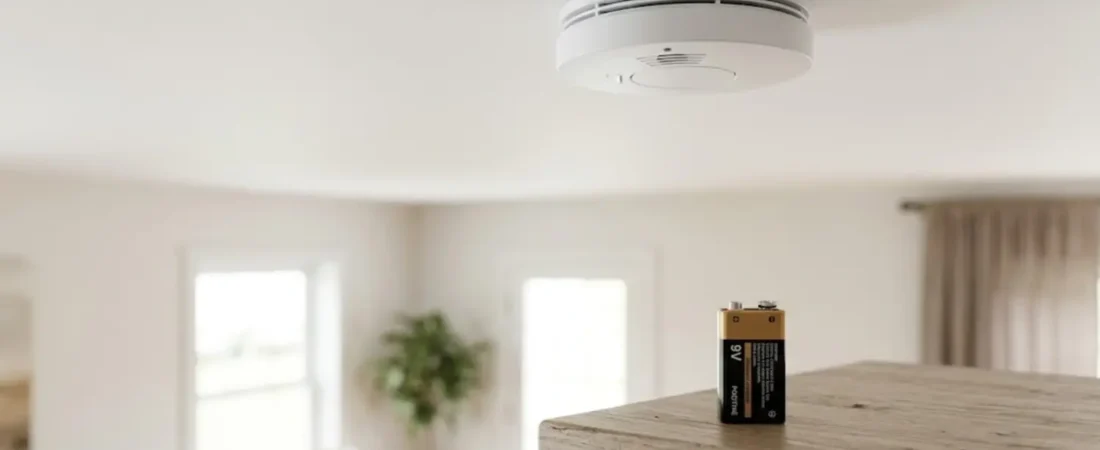
A smoke detector needs a reliable power source to perform its job. If your alarm uses a replaceable 9V battery, choosing the correct replacement and installing it properly are important parts of home safety.
However, not every smoke detector uses a 9V battery. Some use AA batteries, other battery formats, hardwired power with a backup battery, or a sealed long-life battery that is not designed to be replaced by the homeowner. Even among 9V models, the manufacturer may specify a particular chemistry or approved battery list.
This guide explains how to identify the right battery, recognize low-battery warnings, replace a compatible 9V battery, and check that the alarm works afterward.
Does Every Smoke Detector Use a 9V Battery?
No. Smoke detectors and smoke alarms come in several designs. Some use a replaceable 9V battery, while others use different battery sizes or are connected to household electrical power with a backup battery.
The alarm’s model number, battery compartment label, and user manual are the most reliable sources for identifying the correct replacement. Do not choose a battery based only on the shape of the compartment or the fact that another alarm in your home uses 9V power.
If the alarm contains a sealed long-life battery, do not attempt to open or modify it. Follow the manufacturer’s instructions for maintenance and end-of-life replacement.
Which 9V Battery Should You Use?
Alkaline 9V batteries
Many alarms that accept a replaceable 9V battery specify an alkaline model or list approved alkaline replacements. These batteries are widely available and are intended for single use.
Check the manual for the recommended type, replacement interval, and any approved brand or model list. A battery that fits the terminals is not automatically approved for your alarm.
Lithium 9V batteries
Some smoke alarms permit specific primary lithium 9V batteries. These products may offer advantages such as long storage life, but compatibility depends on the alarm design.
Do not assume that every lithium battery is acceptable. The alarm’s manufacturer may specify only particular models or chemistry types.
Rechargeable 9V batteries
Rechargeable batteries should not be used in a smoke alarm unless the manufacturer of that exact alarm explicitly approves the specific battery. Some alarm manuals expressly prohibit rechargeable batteries.
A rechargeable battery may have a different voltage profile or behavior during discharge, so physical fit is not enough to establish safety or compatibility.
For a general comparison of battery chemistries, read our guide to standard 9V battery types and uses.
How to Find the Correct Replacement Battery
Before buying a battery, follow these checks:
- Identify the alarm model. Look for a model number on the alarm’s label or in the original paperwork.
- Read the manual. Confirm the required battery format and approved type.
- Check the compartment label. Some alarms list acceptable battery models directly inside or near the compartment.
- Check the battery’s condition and date. Use a fresh, undamaged battery from a reputable seller.
- Confirm the replacement interval. Follow the schedule specified by the alarm manufacturer.
If the manual lists particular battery models, follow that list rather than substituting a different chemistry based on general battery advice.
Signs That a Smoke Detector Battery Needs Attention
A low-battery chirp is a common warning, but the exact sound pattern varies by alarm. Some devices may also display an indicator or provide a voice message.
If the alarm chirps intermittently, check the manual to determine whether the pattern indicates a low battery, a fault, or another maintenance issue. Do not assume every chirp means the battery is the problem.
Other possible issues include a battery that is not seated correctly, a compartment that is not fully closed, or an alarm that has reached the end of its service life. If the warning continues after a correct replacement, consult the manufacturer’s troubleshooting instructions.
Never disable a smoke alarm or leave it without a working power source while troubleshooting.
How to Replace a 9V Smoke Detector Battery
The exact process varies by model. Use the following general approach only when it matches your alarm’s instructions.
Step 1: Read the manufacturer’s instructions
Confirm the correct battery type and the proper way to open the alarm. Some alarms are hardwired, and their manuals may require specific precautions before servicing.
Step 2: Access the battery compartment
Open the compartment or remove the alarm from its mounting bracket as directed. If a ladder is required, use a stable one and avoid overreaching. Ask for assistance if the alarm is difficult to reach safely.
Step 3: Remove the old battery
Disconnect the old battery carefully without forcing the connector. Inspect the compartment for visible damage or corrosion. If you notice leakage or damage, follow the manufacturer’s safety guidance rather than installing a new battery without investigating.
Step 4: Install the approved replacement
Connect the new battery with the terminals aligned correctly. Place it securely in the compartment and close the cover as instructed. A compartment that does not close properly may prevent the alarm from operating as intended.
Step 5: Test the alarm
Use the alarm’s test button according to the manual. Confirm that the expected audible signal occurs and that the unit returns to normal operation. If the alarm fails the test, consult the manufacturer and do not rely on it until the problem is resolved.
Why Does a Smoke Detector Keep Chirping After a Battery Change?
A new battery does not resolve every alarm warning. Common possibilities include:
- The replacement battery is not the type specified by the manufacturer.
- The battery connector is not firmly attached.
- The compartment or alarm cover is not closed correctly.
- The alarm needs a reset procedure described in its manual.
- Dust, an internal fault, or the end of the unit’s service life is causing the warning.
Follow the model-specific troubleshooting guide. Do not remove the battery and leave the alarm unpowered simply to stop the sound.
How Often Should You Replace a 9V Smoke Detector Battery?
The correct interval depends on the alarm and its manufacturer’s guidance. Some models specify routine replacement at a particular interval, while others use different maintenance requirements. Replace the battery promptly when the alarm indicates low power.
Also check the alarm’s age and service-life label. A fresh battery does not make an expired or faulty smoke alarm safe to keep using. Follow the manufacturer’s instructions for testing, cleaning, battery maintenance, and complete unit replacement.
Safety Tips for Smoke Alarm Batteries
- Keep the alarm powered and functional according to its manual.
- Never use a battery chemistry that the manufacturer prohibits.
- Do not mix old and new batteries or improvise a replacement.
- Do not recharge disposable batteries.
- Test the alarm after battery replacement.
- Keep spare batteries stored safely and away from children.
- Replace the alarm itself when required by its service-life guidance.
Smoke alarms are safety devices, so compatibility and correct operation matter more than choosing the cheapest battery.
Frequently Asked Questions
Can I use any 9V battery in a smoke detector?
No. Use only the battery type or approved models specified by the manufacturer. Some alarms do not use 9V batteries at all.
Is a lithium 9V battery better for a smoke detector?
It depends on the alarm’s approved battery specifications. Some models permit particular lithium batteries, while others require a different type.
Can I use a rechargeable 9V battery in a smoke alarm?
Only if the manufacturer of the exact alarm explicitly allows it. Some models prohibit rechargeable batteries.
What should I do if the alarm chirps after replacing the battery?
Check the battery type, connection, compartment cover, and model-specific reset instructions. If chirping continues, use the manufacturer’s troubleshooting guide and confirm that the alarm has not reached the end of its service life.
Should I test the smoke detector after changing the battery?
Yes. Follow the manufacturer’s test procedure after replacement to confirm the alarm responds correctly.
Final Thoughts
Choosing a 9V battery for a smoke detector starts with identifying the exact alarm model and following its instructions. Alkaline, lithium, and rechargeable batteries are not universally interchangeable, even when they share a similar shape.
Use an approved replacement, install it carefully, and test the alarm afterward. If the warning continues or the unit fails its test, investigate the issue using the manufacturer’s guidance rather than leaving the alarm without reliable power.