

A standard AA alkaline battery has a nominal voltage of 1.5 volts (V). However, rechargeable AA batteries usually have a nominal voltage of 1.2 volts. Both batteries share the same physical size, but their internal chemistry and electrical characteristics are different.
AA batteries, also known as double-A batteries, are commonly used in television remotes, wireless keyboards, computer mice, flashlights, toys, wall clocks, and many other household electronics.
Understanding how many volts a AA battery provides can help you select the right replacement, recognize a weak battery, and avoid compatibility problems with your devices.
In this guide, we explain AA battery voltage by type, compare 1.5V and 1.2V batteries, show how to measure voltage with a multimeter, and explain how voltage changes when multiple AA batteries are connected.
How Many Volts Does a Standard AA Battery Have?
A standard disposable alkaline AA battery has a nominal voltage of 1.5 volts.
This is the voltage rating commonly printed on battery packaging. However, it does not mean the battery always produces exactly 1.50V. Its actual voltage changes depending on its condition, temperature, electrical load, and remaining capacity.
A fresh alkaline AA battery can measure slightly above 1.5V when tested without a connected device. As the battery supplies electricity, its voltage gradually decreases.
For example, Energizer specifies a nominal voltage of 1.5V for its E91 alkaline AA battery.
The voltage you measure can vary because of several factors:
- Battery chemistry: Alkaline, lithium, and rechargeable batteries have different electrical characteristics.
- Remaining capacity: A partially discharged battery may produce a lower voltage than a fresh one.
- Electrical load: A battery’s voltage can drop when connected to a device.
- Temperature: Very hot or cold conditions can affect battery performance.
- Internal resistance: As a battery ages or discharges, its ability to deliver current can change.
Therefore, 1.5V should be understood as the nominal rating rather than a constant measurement throughout the battery’s life.
AA Battery Voltage by Type
The AA designation describes a battery’s physical size, not its chemical composition. Different AA batteries can have different nominal voltage ratings.
Here is a comparison of common AA battery types.
| AA battery type | Nominal voltage | Rechargeable? |
|---|---|---|
| Alkaline | 1.5V | No |
| Zinc-carbon | 1.5V | No |
| Lithium iron disulfide (Li-FeS2) | 1.5V | No |
| Nickel-metal hydride (NiMH) | 1.2V | Yes |
| Nickel-cadmium (NiCd) | 1.2V | Yes |
These differences explain why two batteries with identical dimensions may not have the same voltage or performance.
1. Alkaline AA Battery: 1.5V
Alkaline batteries are among the most widely used AA batteries for everyday household electronics.
They use zinc and manganese dioxide chemistry and have a nominal voltage of 1.5V.
Common applications include:
- Television and air-conditioner remotes
- Wireless keyboards and mice
- Wall clocks
- Children’s toys
- Portable radios
- Battery-powered flashlights
Alkaline batteries are convenient because they are widely available and do not require charging. However, they are designed for single use and should never be recharged.
2. Rechargeable NiMH AA Battery: 1.2V
Nickel-metal hydride (NiMH) batteries are a popular rechargeable alternative to disposable alkaline batteries.
A standard NiMH AA battery has a nominal voltage of 1.2V rather than 1.5V.
This lower rating does not automatically mean the battery is weak or defective. NiMH batteries maintain a relatively stable voltage through much of their usable discharge cycle.
They are particularly useful in devices that consume batteries frequently, such as compatible toys, wireless accessories, and portable electronics.
For example, Energizer’s NH15 rechargeable AA battery datasheet specifies a nominal voltage of 1.2V.
NiMH batteries must be charged using a compatible rechargeable battery charger.
3. Zinc-Carbon AA Battery: 1.5V
Zinc-carbon AA batteries also have a nominal voltage of 1.5V.
They are generally used in basic household electronics that require relatively low power.
Although their nominal voltage is the same as alkaline batteries, their capacity and performance under electrical load can differ.
This means that two 1.5V batteries do not necessarily provide the same operating time in a particular device.
4. Lithium AA Battery: 1.5V
Primary lithium AA batteries, commonly using lithium iron disulfide chemistry, generally have a nominal voltage of 1.5V.
They are different from rechargeable lithium-ion batteries and are not designed to be recharged.
Some specialized rechargeable lithium-ion AA-format products also advertise a regulated 1.5V output. These contain internal electronics that control the output voltage.
Always check the manufacturer’s specifications because different lithium battery technologies should not be treated as interchangeable.
1.2V vs. 1.5V AA Batteries: What Is the Difference?
The main difference between 1.2V and 1.5V AA batteries is their chemistry and nominal voltage.
A typical 1.5V alkaline AA battery is disposable, while a 1.2V NiMH AA battery is rechargeable.
However, voltage alone does not determine how well a battery performs in a particular device.
| Feature | 1.5V Alkaline | 1.2V NiMH |
|---|---|---|
| Chemistry | Alkaline | Nickel-metal hydride |
| Nominal voltage | 1.5V | 1.2V |
| Rechargeable | No | Yes |
| Discharge behavior | Gradually declines | Relatively stable through much of discharge |
| Charging | Not supported | Requires compatible charger |
| Common applications | General household electronics | Frequently used electronic devices |
Can You Replace a 1.5V AA Battery With a 1.2V Rechargeable Battery?
In many cases, yes.
Many electronic devices designed for standard AA alkaline batteries can also operate with compatible 1.2V NiMH rechargeable batteries.
However, compatibility depends on the device’s voltage requirements.
Some electronics may display a low-battery warning earlier when using rechargeable batteries. Others may stop working if their minimum operating voltage is not met.
Before switching battery types, check the manufacturer’s instructions and confirm that the device supports rechargeable NiMH batteries.
How Many Volts Do 2, 3, and 4 AA Batteries Produce?
The total voltage depends on how the batteries are connected.
When batteries are connected in series, their nominal voltages are added together.
For standard 1.5V alkaline AA batteries, the calculations are:
| Number of AA batteries | Total nominal voltage |
|---|---|
| 1 | 1.5V |
| 2 | 3V |
| 3 | 4.5V |
| 4 | 6V |
| 5 | 7.5V |
| 6 | 9V |
Rechargeable 1.2V NiMH batteries produce different totals.
| Number of NiMH AA batteries | Total nominal voltage |
|---|---|
| 1 | 1.2V |
| 2 | 2.4V |
| 3 | 3.6V |
| 4 | 4.8V |
| 5 | 6V |
| 6 | 7.2V |
These calculations apply to series connections, where the positive terminal of one battery connects to the negative terminal of the next.
When batteries are connected in parallel, their voltage generally remains the same, while the available capacity can increase. Parallel battery arrangements require compatible cells and an appropriately designed circuit.
How to Check AA Battery Voltage With a Multimeter
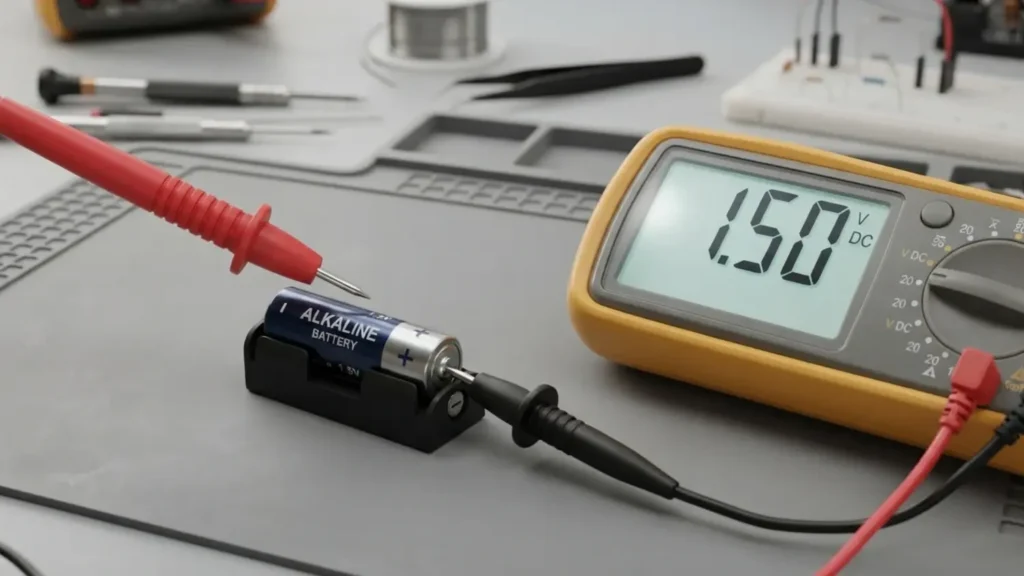
A digital multimeter is a useful tool for measuring AA battery voltage. It can help you determine whether a battery is producing the expected voltage when tested without a connected device.
You do not need expensive equipment for a basic voltage measurement.
What You Need
Prepare the following items:
- A digital multimeter
- The AA battery you want to test
- Red and black multimeter probes
Before testing, inspect the battery for leakage, corrosion, swelling, or physical damage. Do not handle damaged batteries unnecessarily.
Step-by-Step Instructions
Step 1: Turn on the multimeter
Switch on your digital multimeter and make sure the black and red probes are connected to their correct sockets.
Step 2: Select DC voltage mode
Choose the DC voltage setting, usually marked as V with a straight line and a dashed line.
If your multimeter requires manual range selection, choose a suitable range above the battery’s expected voltage.
Step 3: Identify the battery terminals
A standard AA battery has two terminals:
- Positive (+): The raised metal button at the top.
- Negative (-): The flat metal surface at the bottom.
Step 4: Connect the probes
Touch the red probe to the positive terminal and the black probe to the negative terminal.
Keep the probes steady and avoid allowing them to connect directly to each other.
Step 5: Read the measurement
Check the multimeter display to see the measured voltage.
A fresh alkaline AA battery may show a reading slightly above 1.5V without a load. A used battery may show a lower reading.
Remember that an unloaded voltage measurement does not tell you exactly how much usable capacity remains.
For a more complete assessment, an appropriate battery load test can show how the voltage behaves while the battery supplies current.
What Voltage Is Considered Low for a AA Battery?
There is no single low-voltage threshold that applies to every AA battery.
The correct interpretation depends on the battery’s chemistry, discharge conditions, and the operating requirements of the device.
An alkaline AA battery gradually loses voltage as it discharges. A device may stop working when the voltage falls below its minimum operating requirement.
A NiMH rechargeable battery behaves differently. Its voltage generally remains more stable through much of its discharge cycle before dropping more noticeably near the end.
This is why a rechargeable 1.2V battery should not be judged using the same voltage expectations as a disposable 1.5V alkaline battery.
Another important point is that an unloaded voltage reading does not always reveal how well a battery performs under actual operating conditions.
For example, an older battery may show a reasonable voltage on a multimeter but experience a significant voltage drop when connected to a device.
If you suspect a battery is weak, consider its chemistry, age, device performance, and the results of an appropriate load test.
How Long Does a AA Battery Last?
AA battery life depends on its chemistry, capacity, discharge rate, storage conditions, and the device in which it is installed.
For example, an AA battery in a television remote may last considerably longer than one powering a high-drain toy or flashlight.
Several factors influence battery runtime:
Device power consumption: Electronics that draw more current generally consume battery energy faster.
Battery capacity: A battery with greater usable capacity can provide longer operating time under comparable testing conditions.
Usage frequency: A device used occasionally may consume less energy than one operating continuously.
Temperature: Very hot or cold conditions can affect battery performance and available capacity.
Battery age: Long storage periods and unsuitable storage conditions can affect battery performance.
If you want to understand how usage affects battery runtime, read our guide on how long AA batteries last during everyday use.
Can You Use Rechargeable AA Batteries in Everyday Devices?
Rechargeable NiMH AA batteries are suitable for many devices designed to accept standard AA batteries.
They can be especially useful in electronics that consume batteries regularly.
Before using them, consider these points:
- Check the device manual for rechargeable battery compatibility.
- Confirm that the battery has the correct physical size.
- Use a charger specifically designed for NiMH batteries.
- Avoid mixing different battery chemistries.
- Replace batteries in complete matching sets when a device uses multiple cells.
Rechargeable batteries can be a practical long-term option when you frequently use battery-powered electronics.
For more information about battery runtime and the factors that influence it, see our guide to AA battery life and what affects its performance.
Common AA Battery Problems and Safety Tips
Even the correct battery can cause problems if it is old, damaged, incorrectly installed, or stored improperly.
Follow these precautions to use AA batteries safely:
- Check polarity: Match the positive and negative markings inside the battery compartment.
- Avoid mixing battery types: Do not combine alkaline and rechargeable NiMH batteries in the same device.
- Replace batteries together: When a device uses multiple cells, replace the complete set with matching batteries.
- Avoid excessive heat: Keep batteries away from heaters and direct sunlight.
- Never recharge disposable batteries: Ordinary alkaline, zinc-carbon, and primary lithium batteries are not designed for recharging.
- Watch for leakage: Avoid direct contact with leaked battery material and follow the manufacturer’s cleaning and disposal instructions.
- Store batteries safely: Keep loose batteries away from coins, keys, and other metal objects that could connect their terminals.
Following these precautions helps reduce the risk of leakage, overheating, and accidental short circuits.
Frequently Asked Questions
How many volts is one AA battery?
A standard alkaline AA battery has a nominal voltage of 1.5 volts. A rechargeable NiMH AA battery typically has a nominal voltage of 1.2 volts.
Is every AA battery 1.5V?
No. Alkaline, zinc-carbon, and primary lithium iron disulfide AA batteries generally have a nominal voltage of 1.5V. Rechargeable NiMH and NiCd AA batteries typically have a nominal voltage of 1.2V.
Why does a new AA battery measure more than 1.5 volts?
The 1.5V rating represents nominal voltage rather than a maximum open-circuit reading. A fresh alkaline AA battery can measure slightly above 1.5V when it is not connected to a device.
Can I use a 1.2V rechargeable AA battery instead of a 1.5V battery?
Many devices support both types, but compatibility depends on the manufacturer’s voltage and battery requirements. Check the device manual before replacing alkaline batteries with rechargeable NiMH cells.
How many volts do two AA batteries produce?
Two 1.5V alkaline AA batteries connected in series provide a nominal voltage of 3V. Two 1.2V NiMH batteries connected in series provide 2.4V.
Can a multimeter test an AA battery?
Yes. Set the multimeter to DC voltage, connect the red probe to the positive terminal, and the black probe to the negative terminal. The display will show the measured voltage.
Can you recharge a standard 1.5V AA alkaline battery?
No. Standard alkaline AA batteries are disposable and should never be recharged. Only batteries specifically designed for recharging should be used with a compatible charger.
Are AA and AAA batteries the same voltage?
They can have the same nominal voltage when they use the same chemistry. For example, standard alkaline AA and AAA batteries are generally rated at 1.5V. However, they have different physical dimensions and capacities.
Does a higher-voltage AA battery always last longer?
No. Voltage and battery capacity are different specifications. Runtime also depends on chemistry, capacity, electrical load, temperature, and device design.
Final Thoughts
A standard AA alkaline battery has a nominal voltage of 1.5V, while a rechargeable NiMH AA battery typically provides 1.2V.
Although these batteries share the same physical size, their electrical characteristics and discharge behavior are different. The right choice depends on your device’s requirements and whether you prefer disposable or rechargeable batteries.
If you need to investigate a battery’s condition, a digital multimeter can provide a useful voltage reading. However, remember that voltage alone does not always reveal the battery’s remaining usable capacity.
Check the battery label, follow the device manufacturer’s recommendations, and choose the correct battery chemistry to keep your electronics operating reliably.